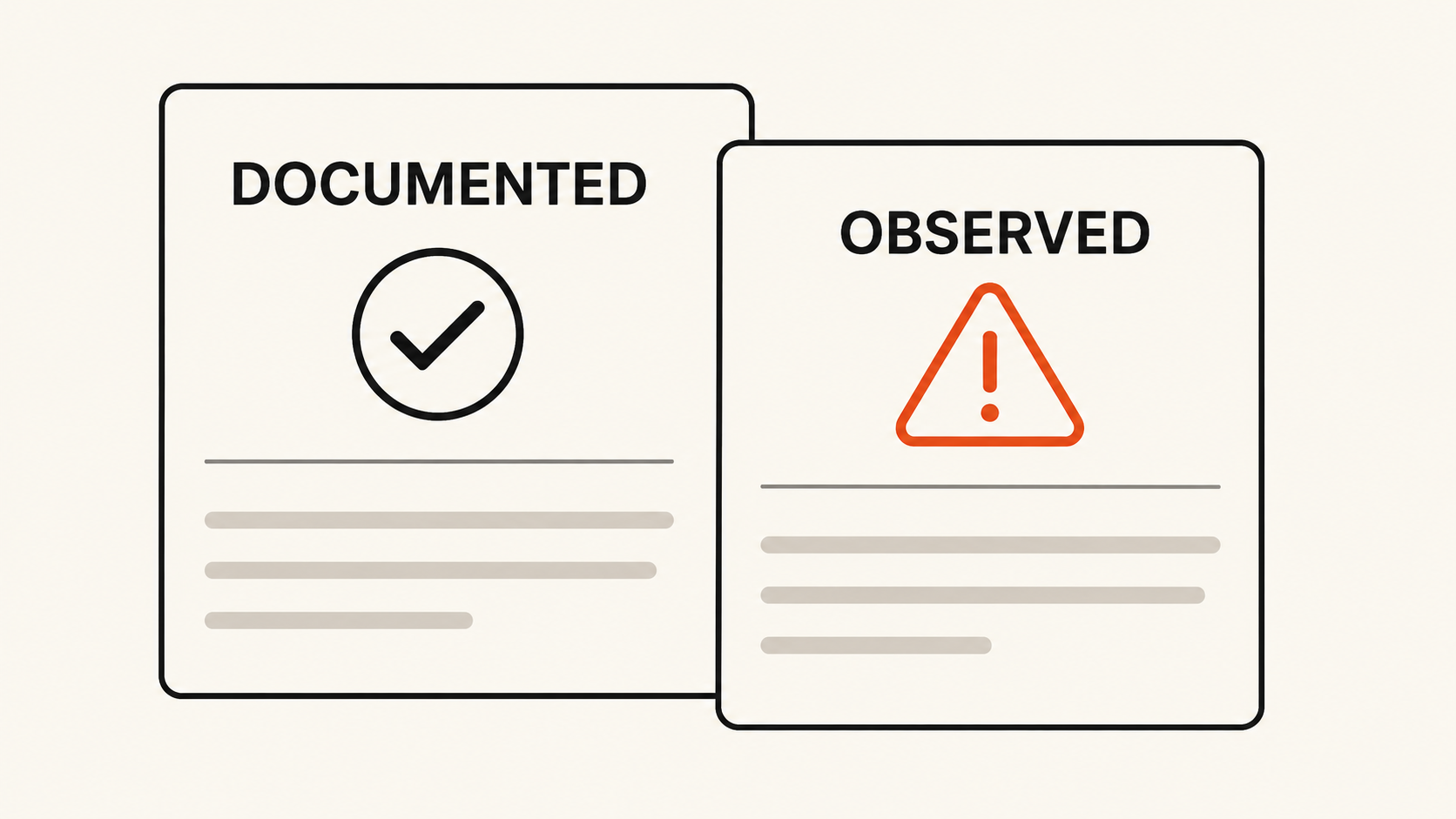
Allow PerplexityBot in robots.txt, publish fresh, well-structured, entity-clear content, and verify access at the server-log level rather than trusting the robots.txt rule alone — because independent testing has found Perplexity’s actual crawling behavior doesn’t always match its documented policy. Recency and format matter more here than backlink authority.
Most Generative Engine Optimization advice — the practice of structuring content so it’s retrieved and cited by AI answer engines like Perplexity and ChatGPT, as distinct from ranking in link-based search results — treats Perplexity like a slightly different Google. It isn’t. Perplexity crawls differently, weights sources differently, and — this is the part most guides skip — doesn’t always behave the way its own documentation says it will.
That last clause is the part worth sitting with before you do anything else.
How PerplexityBot Actually Works (Documented)
Perplexity operates two declared crawlers: PerplexityBot, which builds the index that powers cited answers, and Perplexity-User, which fires when Perplexity’s assistant fetches a page live on a user’s behalf [Perplexity documentation]. Each has independent robots.txt controls — you can allow one and block the other — and Perplexity states that config changes take up to 24 hours to propagate through their systems.
Blocking PerplexityBot removes you from Perplexity’s index entirely. Blocking only Perplexity-User stops live fetches without affecting your indexed presence. That distinction matters more than most GEO checklists suggest — treating “Perplexity access” as a single on/off switch misses half the control surface Perplexity itself documents.
None of this is contested. It’s the baseline. What comes next is where the documentation and the evidence stop agreeing.
The Compliance Gap: What’s Documented vs. What’s Been Observed
Here’s the part most GEO content won’t tell you, because most of it hasn’t checked: allowing PerplexityBot in robots.txt does not guarantee that’s the only way Perplexity accesses your site.
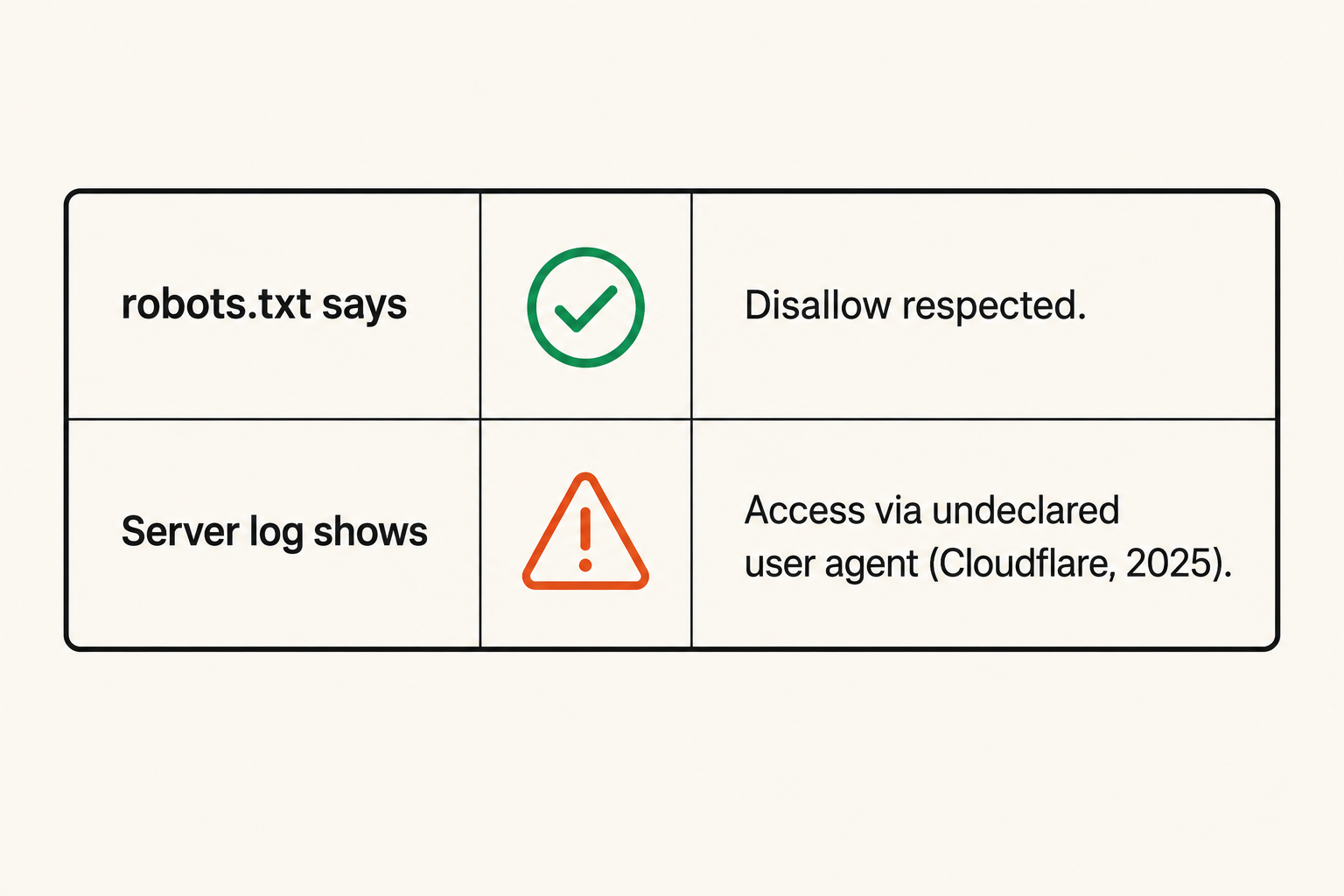
Cloudflare published findings in August 2025 documenting Perplexity using undeclared, rotating-user-agent crawling — changing IPs and ASNs — to access sites that had explicitly disallowed both PerplexityBot and Perplexity-User in robots.txt. Cloudflare subsequently de-listed Perplexity as a verified bot over it [Cloudflare, 2025]. Perplexity publicly disputed the findings — a company spokesperson called the report a “publicity stunt” and disputed Cloudflare’s attribution, telling reporters the flagged traffic didn’t originate from Perplexity’s crawler [reporting on Perplexity’s response, 2025]. The two accounts of what happened remain in direct conflict.
This isn’t an isolated complaint. Developer Robb Knight documented a similar pattern back in 2024: a page blocked by both robots.txt and a server-level 403 got summarized accurately by Perplexity anyway, with server logs showing a generic browser user agent instead of the declared PerplexityBot string [Robb Knight, 2024].
The practical implication — this is the part no general GEO article connects — is that robots.txt is a policy statement, not a verification method. If you’re optimizing for Perplexity citation, checking your server logs for what’s actually hitting your disallowed paths tells you more than reading Perplexity’s crawler docs or its rebuttal does. For the full walkthrough on catching this on your own site, see how to verify PerplexityBot can access your site.
Does Perplexity Depend on Bing’s Index? (Inferred — Not Settled)
You’ll find confident claims on both sides of this one, and neither is backed by current Perplexity documentation. Earlier analysis framed Perplexity as leaning on Bing’s index for live retrieval, passing user queries through as background Bing searches [third-party analysis, 2025]. More recent analysis describes Perplexity running its own continuous crawl and retrieval pipeline, with any Bing dependency reduced to a supplementary role at most [third-party analysis, 2026].
We’re labeling this Inferred rather than Documented because Perplexity hasn’t confirmed either version publicly, and the two most-cited third-party takes disagree. If your GEO strategy hinges on Bing Webmaster Tools submission specifically because of Perplexity, that’s a bet on an unconfirmed mechanic — worth doing anyway for Copilot and general Bing-index coverage, just not on the strength of a settled Perplexity claim.
Recency vs. Authority: How Perplexity Actually Weights Freshness (Documented + Observed)
This one’s more solid. Perplexity crawls live at query time rather than relying on a training-data cutoff, and both Perplexity’s own materials and independent analysis converge on the same conclusion: Perplexity has a stronger recency bias than Google’s authority-accumulation model [Perplexity documentation; third-party analysis, 2026]. Content published or meaningfully updated within roughly the last 90 days gets a visible boost in citation likelihood, independent of how long your domain has existed.
This is the mechanic behind why a newer domain with almost no backlink history can still get cited quickly for a timely, well-structured answer — something we’ve observed directly. See what our first-party data showed about AI citation timing on a new site for the specifics of what that looked like on ideapreneur.io.
Quick Search vs. Pro Search: The Real Difference (Documented, Modest)
Perplexity’s own help documentation confirms Pro Search “pulls from a broader range of sources” for more in-depth answers than standard search [Perplexity Help Center]. Independent testing corroborates the shape of it: Quick Search tends toward instant, surface-level answers from a handful of sources, while Pro Search runs multi-step reasoning across a wider source pool before answering [independent testing, 2026].
What we won’t claim: that the two modes use fundamentally different citation mechanics. One analysis of citation behavior across tiers found the underlying selection process is the same — Pro Search and Deep Research just draw from a wider candidate pool before that process runs [third-party analysis, 2026]. If you’re optimizing content, the takeaway is to write for depth and specificity that survives a wider comparison set, not to build separate content for each mode.
Content Format Signals Perplexity Responds To (Documented + Observed)
Independent analysis of Perplexity’s retrieval pipeline consistently points to the same format signals: content that leads with a direct answer before supporting detail, clear single-entity focus (pages that split attention across multiple subjects perform worse), and structural elements — short paragraphs, headers, bullet points — that make extraction easy [third-party analysis, 2026]. This is Answer-First Chunking in practice: state the answer, then the evidence, then the context — not the reverse.
Domain authority still matters, but it’s evaluated alongside cross-source consensus — if your claim contradicts what other credible sources say on the same topic, third-party analysis suggests it’s less likely to get cited even when well-written [third-party analysis, 2026]. Structure your claims so they’re checkable, not just confident.
Common Mistakes That Keep You Out of Perplexity Citations
The biggest one is treating a robots.txt allow rule as proof of compliance rather than a policy setting — see the compliance gap above. The second is assuming Perplexity works like Google AI Overviews or ChatGPT search; each platform’s retrieval pipeline is genuinely different, and content built for one doesn’t automatically transfer. The third is publishing evergreen content and never touching it again — given Perplexity’s recency weighting, an update timestamp matters more here than on a typical SEO-first page. The fourth is padding content with hedged, vague claims to avoid being wrong; Perplexity’s cross-source consensus check penalizes vagueness as much as it penalizes contradiction — specific, checkable claims perform better even when they carry more risk.
FAQ
How does Perplexity choose which sources to cite?
Perplexity runs a two-stage process. First, a retrieval step pulls candidate pages based on how closely they match the query and existing authority signals. Second, a separate ranking model scores those candidates on relevance, freshness, structural clarity, and consensus with other credible sources before deciding which ones actually get cited. Independent analysis describes this as closer to a pass/fail gate than a graduated ranking — a page either clears all the filters and earns a citation slot, or it’s dropped entirely, with no equivalent to page two of Google results. Of roughly ten pages a typical query retrieves, only three to four are usually cited in the final answer.
What makes a website appear in Perplexity answers?
At minimum, PerplexityBot needs to be able to reach the page — verified via a robots.txt allow rule and, more reliably, via server-log confirmation, given the documented dispute over whether Perplexity’s crawling always matches its stated policy. Beyond access, content needs a clear single-entity focus rather than splitting attention across multiple subjects, an answer-first structure that states the point before the supporting detail, and reasonably recent publication or update dates, since Perplexity weighs freshness more heavily than a typical search engine.
How do I optimize my content for Perplexity?
Lead every section with a direct answer before adding supporting detail — Perplexity’s retrieval pipeline extracts from the opening portion of a page most often. Keep each page focused on one clearly identified subject; pages that discuss multiple entities without a clear primary focus tend to fail the entity-clarity checks in Perplexity’s ranking process. Use short paragraphs, headers, and structural elements that make individual claims easy to extract on their own. Finally, keep time-sensitive content updated regularly, since Perplexity’s recency weighting rewards visibly current pages over older, unchanged ones.
Does Perplexity use the Bing or Google index?
This isn’t settled, and no confident answer here should be trusted, including this one. Earlier analysis described Perplexity as leaning on Bing’s index to supply live search results behind the scenes. More recent analysis describes Perplexity relying mainly on its own continuous crawl and retrieval pipeline, treating any external index as a supplementary source at most rather than a core dependency. Perplexity itself hasn’t confirmed either account publicly. If your GEO strategy depends specifically on Bing Webmaster Tools because of an assumed Perplexity relationship, that’s a bet on an unconfirmed mechanic rather than a documented one.
Does PerplexityBot always respect robots.txt?
Perplexity’s documentation says its declared crawlers do. Cloudflare published a report in August 2025 stating it observed Perplexity accessing robots.txt-disallowed sites using undeclared, rotating user agents and IP ranges, and subsequently de-listed Perplexity as a verified bot. Perplexity publicly disputed this — a spokesperson called it a publicity stunt and said the flagged traffic wasn’t theirs. Independent developer testing in 2024 found a similar pattern on a smaller scale. Neither side has fully reconciled the discrepancy since. For site owners, the safest approach is server-log verification rather than trusting either account at face value.
What’s the difference between Quick Search and Pro Search for citations?
Perplexity’s own documentation confirms Pro Search draws from a broader range of sources than standard search, aimed at more in-depth answers. Independent testing supports the shape of that difference: Quick Search tends to return fast, surface-level answers from a small number of sources, while Pro Search runs multi-step reasoning across a wider pool before answering. What isn’t well-supported is a claim that the two modes use different citation mechanics — one analysis found the underlying selection criteria appear consistent across tiers, with only the size of the candidate pool changing.
Perplexity citation isn’t a checklist you complete once. It’s recency-sensitive, entity-sensitive, and — based on the evidence above — not fully governed by the access rules Perplexity documents, or fully settled by Perplexity’s rebuttal of the evidence against it either.
Getting cited by Perplexity isn’t one fix — it’s crawler access, schema, and citation-ready content working together. For the broader diagnostic on why a brand isn’t showing up in AI answers at all, start with the full AI search visibility diagnostic.
Citation Foundation covers crawler access, schema, and citation-engineered content together — the full path to Perplexity visibility.
See Citation Foundation — $997 →