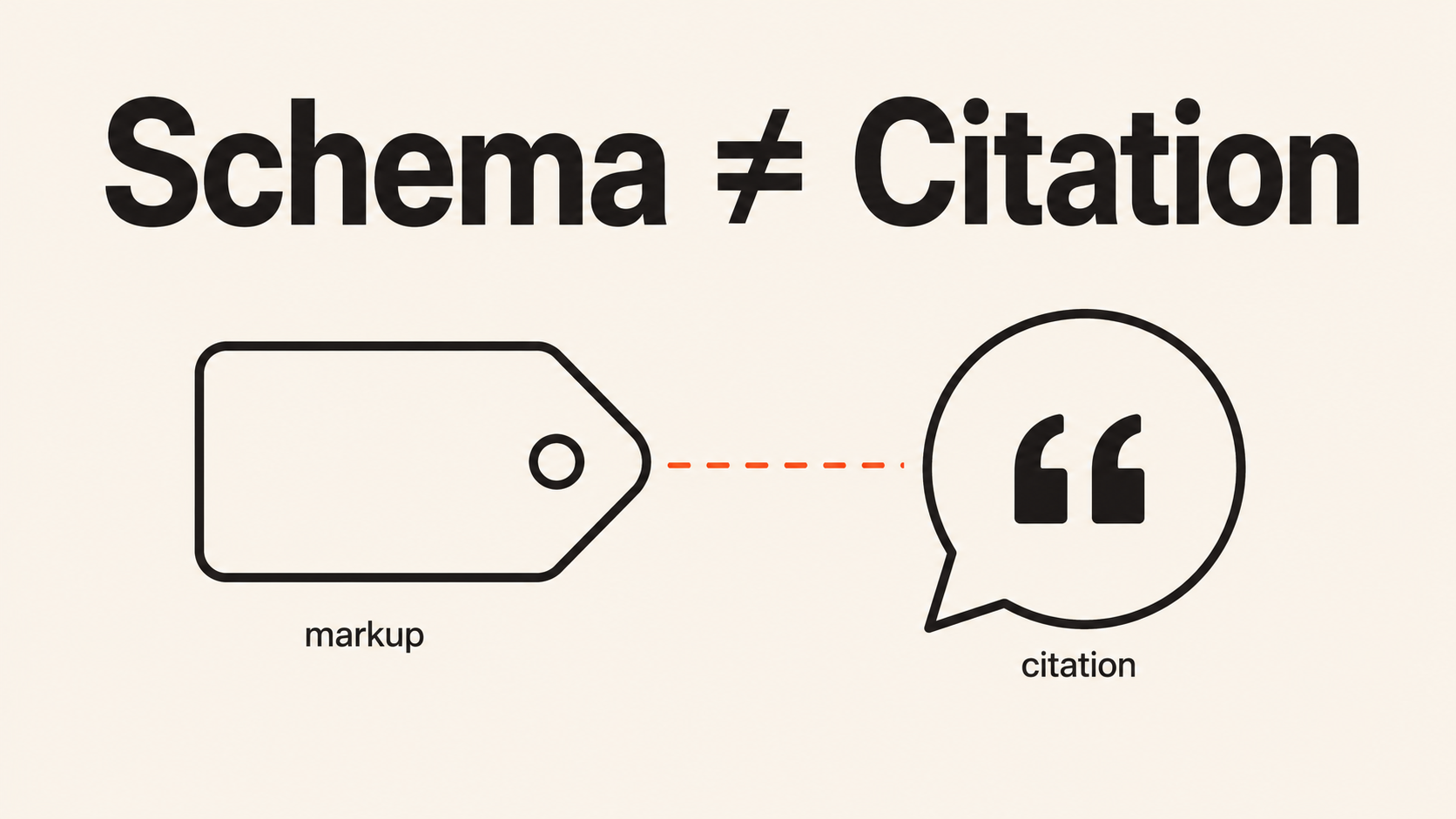
Schema markup doesn’t cause AI citations. It’s parsing infrastructure — and per Google’s own 2026 guidance, not a requirement for AI Overview eligibility. If your JSON-LD validates but you’re still uncited, the fix isn’t more schema. Run this three-step diagnostic instead: verify implementation, confirm AI crawlers are actually parsing the page, then check whether the real bottleneck is content depth.
This is the deeper version of a question our full AI search visibility diagnostic covers at a higher level — this piece narrows in specifically on where schema fits, and where it doesn’t.
The Belief That’s Costing You Time: “Schema = Citations”
Somewhere in the last two years, a reasonable-sounding claim hardened into an assumption: add structured data, get cited by AI. It’s reasonable because schema.org markup genuinely does something — it labels your content in a machine-readable format that search engines and AI systems can parse more reliably than raw HTML. The assumption breaks because “parse more reliably” got quietly upgraded to “get cited,” and those aren’t the same claim, even before you get to the newer evidence that the gap between them is wider than most guides admit.
Here’s the distinction the assumption erases: schema is infrastructure, not persuasion. That framing has become close to industry consensus at this point — most current writing on the topic lands somewhere near “infrastructure, not a magic bullet.” Where this article differs isn’t the framing. It’s what comes after: a sequenced way to actually find out which layer of your setup is the real problem, instead of defaulting to “add more schema” because that’s the layer with a checklist.
Marketing teams implement Article schema, FAQPage schema, maybe HowTo schema where it fits, run the Rich Results Test, get a green checkmark, and wait. When citations don’t materialize, the instinct is to add more schema — more types, more properties, deeper nesting. That instinct was already questionable. As of 2026, there’s direct evidence it’s usually wrong.
What Schema Markup Actually Does for AI Search
Structured data’s job is disambiguation. When an AI system’s retrieval pipeline pulls your page, it’s trying to answer a narrow question: what is this content, who wrote it, when was it published, and what claim does this specific paragraph make? Well-formed JSON-LD answers those questions explicitly instead of forcing the system to infer them from unstructured HTML.
That function is real and platform-confirmed, not just theoretical, for exactly two platforms. Fabrice Canel, principal product manager at Microsoft Bing, confirmed on stage at SMX Munich in March 2025 that structured data helps Bing’s systems interpret page content for Copilot. Google’s search team made a similar statement not long after. Bing Copilot and Google AI Overviews are the only platforms with an on-the-record confirmation that they use schema this way — ChatGPT and Perplexity have not issued an equivalent statement, which matters if Perplexity is your primary citation target, since the confirmed benefit doesn’t automatically transfer.
What neither confirming platform has said is that schema determines whether a page gets cited. That distinction became explicit in May 2026, when Google published its own official guidance on structured data and AI Overviews eligibility — stating directly that markup is not required for AI Overview or AI Mode inclusion, and that both run primarily on content quality, authority, and relevance. A large-scale controlled study from Ahrefs makes the same point empirically: tracking 1,885 pages that added schema between August 2025 and March 2026 against 4,000 control pages, the study found no statistically meaningful citation lift across Google AI Overviews, AI Mode, or ChatGPT — ChatGPT’s movement (+2.2%) fell within statistical noise.
None of that makes schema pointless. It makes it exactly what the name suggests: infrastructure that helps a system understand what it’s already decided, on other grounds, to retrieve. It cannot manufacture a direct answer that doesn’t exist in your prose, cannot make a vague claim specific, and cannot get a page cited that a crawler never reaches in the first place.
The Three-Step Diagnostic
If schema isn’t producing citations, the question isn’t “what schema am I missing.” It’s “which layer is actually broken.” There are three candidates, and they sit in a strict order — each one only matters if the layer before it checks out.
- Is the schema implemented correctly? A syntax error or a mismatched field silently disqualifies the whole block.
- Is the content being parsed by AI crawlers at all? Perfect schema on a page no crawler reaches is invisible by default.
- If both check out — is the real problem a citation probability floor? Content depth, entity recognition, or answer structure that schema was never going to fix, and that the 2026 evidence above suggests is where most of these cases actually land.
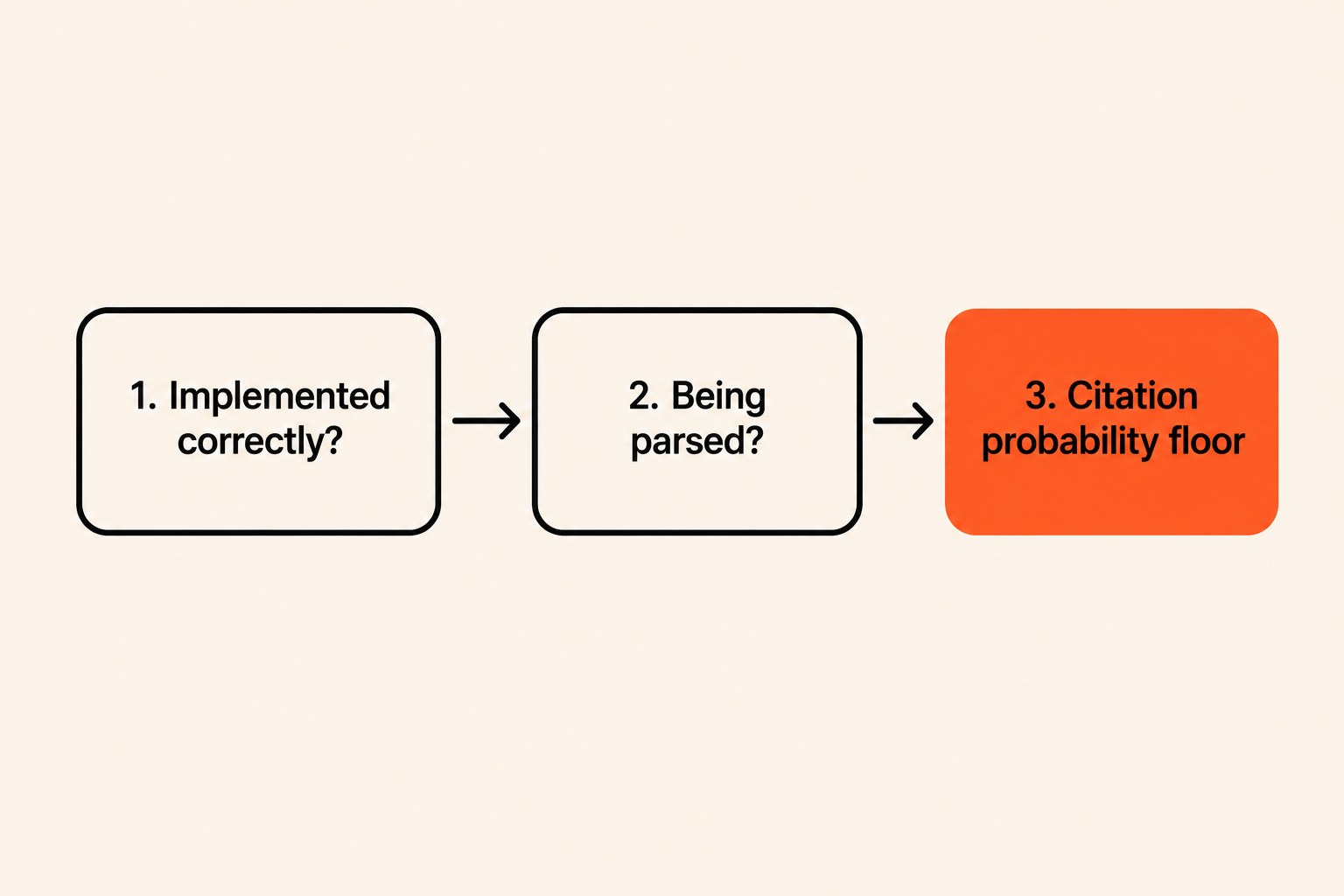
Work the list in order. Skipping to step three because it’s the more interesting problem, while steps one and two are still unverified, is the single most common reason this diagnostic gets run backward.
Step 1: Validate Implementation
Run the URL through Google’s Rich Results Test and cross-check with the Schema.org Validator. Look specifically for three failure modes that pass a casual glance but fail structurally: mismatched @type values (an FAQPage block nested inside content that isn’t actually formatted as question-and-answer), missing required properties (an Article schema with no author or datePublished), and — the one that gets missed most often — schema describing content that isn’t actually rendered on the page. A FAQPage block referencing six questions when only three appear in visible HTML is not a minor inconsistency; some systems treat it as a signal the markup is unreliable and discount the whole block.
If step 1 fails, fix it and re-test before moving on. There’s no diagnostic value in checking parsing or content depth against schema that’s broken at the source.
Step 2: Confirm AI Crawlers Are Actually Parsing It
Schema that validates perfectly is still worthless if the crawler carrying it never fires. This is the step teams skip most often, because it feels like a solved problem — “of course Googlebot can reach the page” — without checking whether the AI-specific crawlers can. OAI-SearchBot, PerplexityBot, and Google’s AI Overview crawling behavior aren’t guaranteed to follow the same access patterns as traditional search crawlers, and a robots.txt rule, a JavaScript-rendering dependency, or a CDN configuration can block one without visibly affecting the others.
The fastest confirmation path is server log inspection — filtering for the specific AI crawler user-agent strings and confirming recent hits against the exact URL in question, not just the domain. If you don’t have log access, Search Console’s URL Inspection tool combined with a manual crawler-behavior check is the fallback, though it’s a weaker signal for AI-specific bots than it is for Googlebot. We’ve written the full walkthrough for this separately — see confirming AI crawlers can access your site before schema work rather than repeating it here.
If step 2 fails, that’s the whole answer. No amount of schema fixes a page the crawler never sees.
Step 3: The Citation Probability Floor
This is the step people want to skip to, and — per the 2026 evidence above — the step that actually explains most “my schema is perfect and I’m still not cited” cases. If implementation is clean and crawling is confirmed, the remaining explanation is that the content itself sits below the probability floor for citation, regardless of how well it’s labeled.
Three things drive that floor, and none of them are schema problems. Content depth — a page that restates consensus in slightly different words has nothing distinctive for a retrieval system to prefer over the ten other pages saying the same thing; schema can’t manufacture a claim that isn’t there. Entity recognition — if your organization, author, and topic aren’t consistently and specifically named across the page, the retrieval system has less to anchor a citation to, independent of what the schema claims. Answer structure — AI systems extract citation-sized chunks: a direct answer, self-contained, extractable without surrounding context. A page that only gets to its actual answer three paragraphs into throat-clearing is structurally harder to cite even with flawless FAQPage markup wrapped around it.
There’s a fourth factor worth naming even though it isn’t fixable on-page at all: Muck Rack’s May 2026 analysis of more than 25 million AI-cited links found earned media — third-party coverage and editorial mentions, not brand-owned content — accounts for 84% of AI citations, consistent with the 82–89% range the same study has held across three editions since mid-2025. That’s a floor no amount of schema, or even content quality alone, moves by itself. It’s a reason distribution and off-site presence matter as much as the page you’re optimizing.
Answer structure is a content-structure problem, not a schema problem, and it’s the one we go deep on in the content structure optimization for AI citation spoke — worth reading in full if step 3 is where you land, since fixing it is a rewrite, not a markup change.
We didn’t get this order right on the first pass, either. Schema went in early on this site’s own self-case-study, before content was restructured to answer-first — and the first confirmed citation, in June 2026, came from a page whose schema was solid but whose content hadn’t been touched yet. One data point, not a rule. But it lines up with what Ahrefs found at scale: the schema wasn’t holding anything back.
Common Mistakes
Treating schema as a ranking or citation factor. It isn’t, for traditional search, and Google’s own 2026 guidance now says so directly for AI Overviews too. It affects parsing reliability and, in narrower cases, eligibility for certain rich result formats — a real but narrower claim than “citation boost.”
Assuming FAQPage schema still earns rich-result treatment by default. Google curtailed FAQ rich-result eligibility starting in August 2023, and a May 2026 update removed nearly all of what remained, outside government and health sites. FAQPage markup can still help AI systems parse question-and-answer structure — it just no longer reliably buys traditional rich-result placement.
Schema-describing content that doesn’t exist on the page. Any block that references content not actually rendered in HTML is a liability, not a hedge. Fix the mismatch in one direction: either add the content or remove the schema claim.
Skipping straight to step 3. Content-depth work is more interesting than log-file inspection. It’s also useless if step 2 was the actual failure, which is invisible without checking.
FAQ
Does schema markup help with AI search?
Yes, but indirectly, and the evidence for how much is thinner than most guides suggest. Schema markup helps AI systems parse and disambiguate your content — clarifying authorship, publication date, and where one answer ends and the next begins. Microsoft Bing’s Fabrice Canel confirmed in March 2025 that structured data helps Bing’s systems interpret page content for Copilot. But Google’s own 2026 guidance on optimizing for AI-powered search states structured data isn’t required for AI Overview or AI Mode eligibility, which run primarily on content quality, authority, and relevance. Schema removes a potential parsing barrier upstream of citation — it doesn’t independently cause it.
Why isn’t my structured data getting me AI citations?
Most often because structured data isn’t the actual bottleneck. Run the three-step diagnostic: confirm the schema is implemented correctly using the Rich Results Test, confirm AI crawlers are actually reaching and parsing the page via server logs, and if both pass, look at content depth, entity consistency, and answer structure instead. A large-scale Ahrefs study tracked 1,885 pages that added schema between August 2025 and March 2026 against 4,000 control pages and found no statistically meaningful citation lift across Google AI Overviews, AI Mode, or ChatGPT. Schema correctness rarely explains a citation gap on its own once implementation and crawling both check out.
What schema types help with Google AI Overviews?
Article schema still supports authorship and publication clarity, which helps disambiguation. FAQPage schema is more complicated than it looks: Google began curtailing FAQ rich-result eligibility in August 2023, and a May 2026 update removed nearly all remaining eligibility outside government and health sites. That doesn’t make FAQPage schema useless for AI citation generally — it can still help platforms like Perplexity and ChatGPT parse question-and-answer structure during retrieval — but it no longer reliably earns the traditional rich-result treatment in Google Search. Treat FAQPage as a parsing aid, not an eligibility guarantee, and don’t expect it alone to move Google AI Overview inclusion.
Is JSON-LD required for AI citation?
No. JSON-LD is the recommended implementation format for schema.org markup because it’s the easiest to validate and least likely to break page rendering, but AI systems can and do cite pages with no structured data at all when the underlying content is clear, well-structured, and directly answers the question being asked. Google’s 2026 guidance on AI-powered search explicitly states structured data isn’t a requirement for AI Overview or AI Mode inclusion. JSON-LD makes your content easier to parse correctly and reduces ambiguity, which is a real benefit — it just isn’t a prerequisite for being cited.
How do I check if my schema markup is actually working?
Run the URL through Google’s Rich Results Test and a schema.org validator to confirm syntax and required properties are present. That confirms the markup is technically valid — it doesn’t confirm the markup matches reality, which is the check most teams skip. Cross-reference every schema claim against the rendered page: an FAQPage block referencing questions that aren’t visible in the actual HTML, or an Article schema missing a resolvable author, will get discounted by systems that check markup against rendered content rather than trusted at face value. Passing validation is step one of the diagnostic, not the whole answer.
If my schema is correct and my content is being crawled, why am I still not cited?
That combination points to step three of the diagnostic: the citation probability floor. If implementation is clean and crawling is confirmed, the content itself likely sits below what the retrieval system needs to prefer it over competing sources — thin coverage, weak entity consistency, or an answer buried several paragraphs into the page instead of stated up front. This tracks with what large-scale testing has found: Ahrefs’ 2026 study of schema additions across nearly 2,000 pages found no meaningful citation lift, which suggests the ceiling on what schema alone can fix is lower than most implementation-focused advice assumes. The fix at this stage is a content rewrite, not a markup change.
Does adding more schema types increase my chances of being cited?
Not by itself, and it can backfire. Adding schema types that don’t correspond to actual rendered content on the page is more likely to get the markup discounted than to help, since systems increasingly cross-check schema claims against visible page content. Google’s 2026 guidance on AI-powered search is explicit that structured data isn’t a requirement for AI Overview eligibility, and Ahrefs’ controlled study found no meaningful citation gain from adding schema at scale. Add a schema type when the content structure genuinely supports it — a real FAQ section, real numbered steps, a real dated author — not as a general-purpose visibility tactic layered on top of thin content.
Structured data is the layer most teams check first because it’s the most concrete thing to fix — a checklist, a validator, a green pass. That’s exactly why it’s also the layer most likely to get blamed for a problem it isn’t causing, and why Google’s own 2026 clarification on this matters more than another schema tutorial would. If you’ve run all three steps and the floor in step 3 turns out to be the answer, the content structure optimization for AI citation piece picks up exactly where this one stops — or for the wider picture first, the full AI search visibility diagnostic is the place to start.
If schema, crawler access, or llms.txt is where your citation gap actually lives, Citation Infrastructure Setup fixes all three in one pass.
See Citation Infrastructure Setup — $397 →