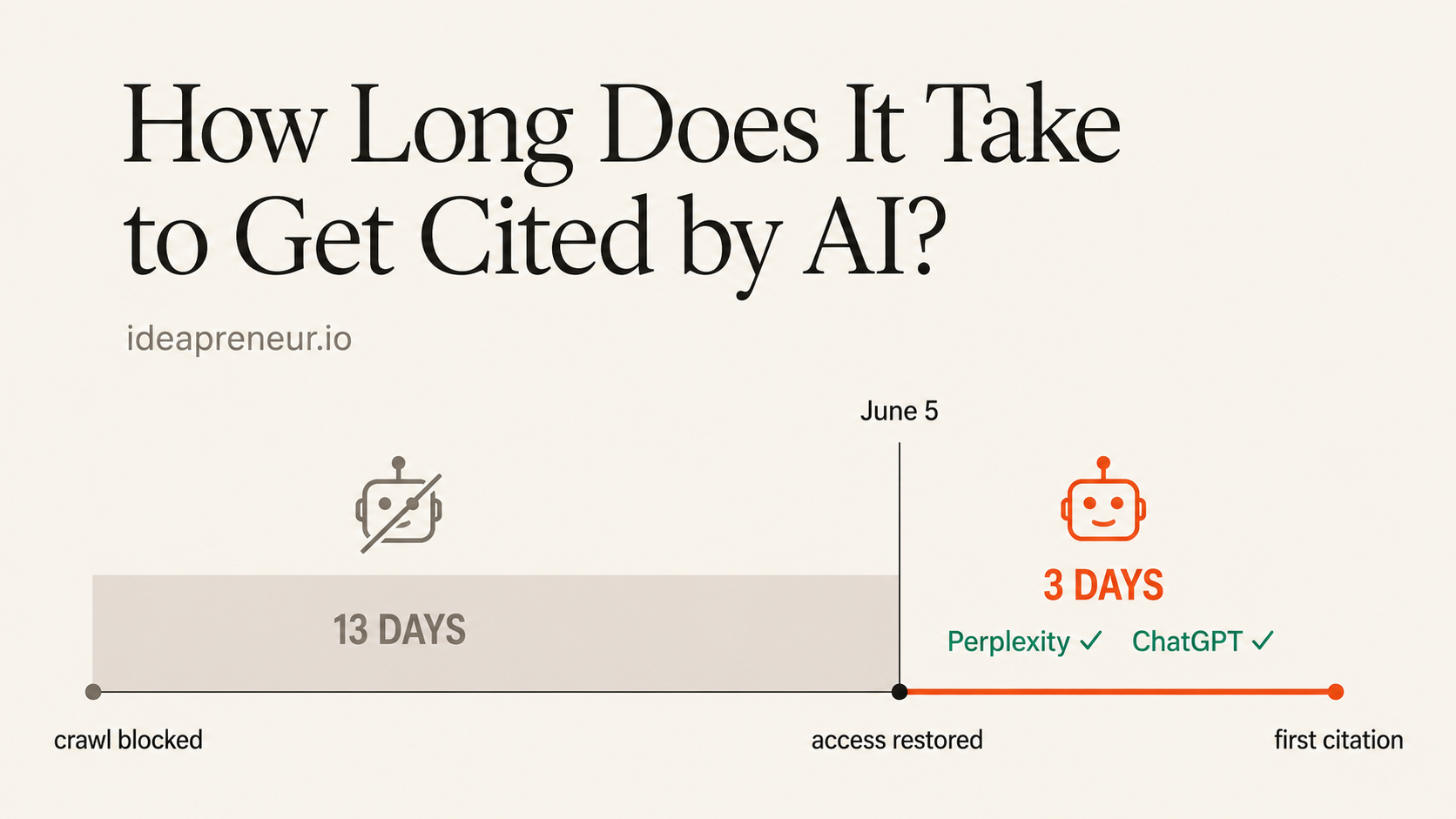
The most common question in AI search visibility is also the one with the least data behind it: how long does it actually take for AI platforms to start citing a new site? On ideapreneur.io — a fresh domain with zero history — Perplexity and ChatGPT both made their first citations on June 8, 2026: day 16 post-launch. The effective window from restored crawl access to first citation was approximately three days. A robots.txt misconfiguration blocked AI bot access for 13 of those 16 days.
This is not a benchmark. It is a record of what happened on one site, tracked against two AI platforms, with scope limitations written as a full section rather than a footnote. Google AI Overview data is excluded — that section in Google Search Console was not yet available at time of writing. We are publishing this because observed data at n=1 is more useful than the general advice currently filling the SERP for this question.
What We Tracked and How
The domain: ideapreneur.io, registered May 15, 2026. No prior content, no domain authority, no backlink profile. One article was live at full launch on May 23, 2026. Additional cluster articles were published between May 23 and June 14 as part of the AI Citation Engineering content cluster.
The platforms: Perplexity and ChatGPT (web search-augmented mode). Google AI Overview monitoring is ongoing via Google Search Console but excluded here pending data availability.
What counted as a citation event: A platform response that named ideapreneur.io as a source or linked to a specific article URL in the response body. Indexed does not count. Crawled does not count. Cited counts — meaning the platform actively selected the content as a source during response generation. Confirmed via Bing Webmaster Tools, Google Search Console, and manual incognito query runs on fresh browser instances with no login state.
Verification method for ChatGPT: Five independent incognito sessions across fresh browser instances, no account login. Three structured analytical runs examining citation consistency across response types. Result: 3/3 runs cited the same pillar article, with consistent sourcing on specific subtopic categories across all three runs.
The pre-fix picture: Server logs showed PerplexityBot and OAI-SearchBot attempting to access the site repeatedly between May 23 and early June — and failing. Request rejections were the dominant signal. We weren’t tracking a clean timeline. We were watching bots hit a wall.
The Timeline — From Launch to First Citation
May 15, 2026 — Domain registered. No content.
May 23, 2026 — Full launch. First article published. robots.txt and sitemap were already misconfigured — an artifact of switching from static HTML to Astro during the build. The new framework output a configuration that blocked AI crawler access. We didn’t know it yet.
May 23 – June 5, 2026 — Server logs showed PerplexityBot and OAI-SearchBot attempting access on multiple occasions. Frequent request rejections throughout this window. Citations across both platforms: zero.
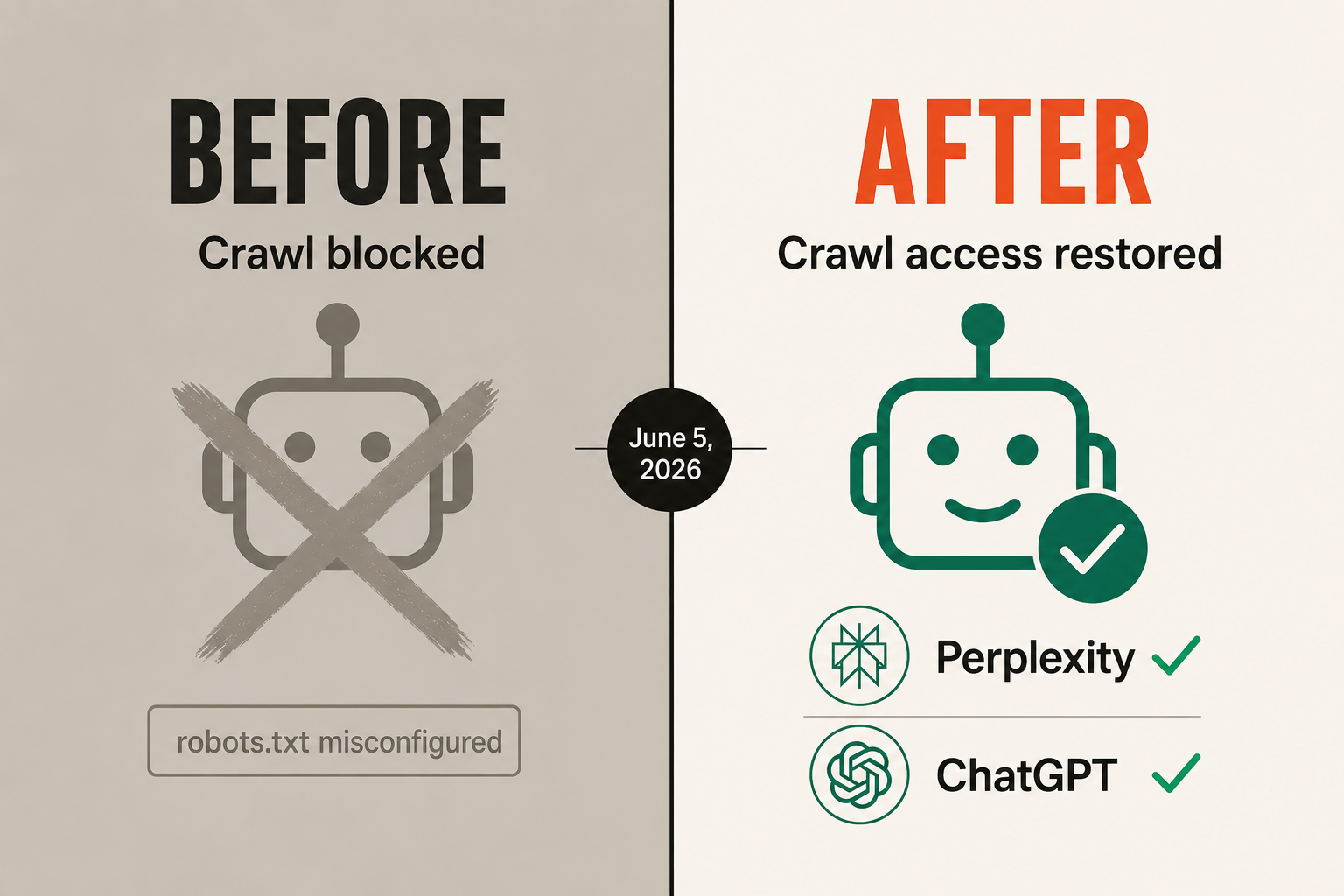
June 5, 2026 — Crawl access fixes applied. robots.txt and sitemap corrected. The block was not intentional — it was an inadvertent artifact of the Astro migration, not a deliberate configuration choice. Removing it was not an optimization move. It was eliminating a barrier that should never have existed.
June 5–8, 2026 — Server logs showed a measurable decline in request rejections. Bots were getting through.
June 8, 2026 — First citations confirmed on Perplexity and ChatGPT on the same day. What Is AI Citation Engineering? was the first article cited on both platforms. Answer-First Chunking: Why AI Skips Your Content became the most cited article within a few days.
June 14, 2026 — Why Your Brand Isn’t Showing Up in AI Answers published. Cited by ChatGPT on the day of publication — zero lag between publish and first citation. With crawl access confirmed and entity recognition already established from the June 8 window, the new article entered the citation pipeline immediately. Bing Webmaster Tools citations reached 136 within the first tracking window, a figure that doubled within days, with this article driving the majority.
Citation events also appeared in German-language queries, despite all published content being in English.
| Platform | First Citation Date | Days Post-Launch | Article First Cited | Observable Preceding Event |
|---|---|---|---|---|
| Perplexity | June 8, 2026 | Day 16 | What Is AI Citation Engineering? | Crawl access restored ~June 5 |
| ChatGPT | June 8, 2026 | Day 16 | What Is AI Citation Engineering? | Crawl access restored ~June 5 |
| Google AI Overview | Not yet confirmed | — | — | — |
Effective window from crawl access restored to first citation: approximately 3 days.
Secondary finding: once crawl access and entity recognition are established, new articles can enter the citation pipeline on publish day.
What Appeared to Precede Each Citation Event
Being precise about the language here. “Appeared to precede” is not “caused.” With n=1, the most we can honestly say is: these conditions were in place, and citations followed. Patterns observed. Causation not established.
Crawl access was the gate. For 13 days, AI bots tried to reach ideapreneur.io and failed. Citations were zero. Access was restored around June 5. Citations arrived within three days. The content hadn’t changed. The domain hadn’t aged. No new backlinks appeared. The only variable that changed materially was crawl access. That’s as close to an isolated variable as a real-world n=1 observation allows — not a controlled experiment, but an inadvertent natural one.
Citation Architecture signals were in place at launch. The articles published before June 8 used Answer-First Chunking, entity-dense writing, FAQ schema, structured definitions, and intent-mapped headings. We cannot separate these from the crawl variable. What we can note: the article cited first on both platforms — What Is AI Citation Engineering? — and the article that became most-cited shortly after — Answer-First Chunking — are the articles most explicitly structured for extraction.
ChatGPT cited a specific territory, not the whole site. Across three structured analytical runs conducted in June 2026, ChatGPT’s search layer cited the pillar article on specific subtopics: entity recognition, content and AI-friendliness, and recency and indexing. On two of those subtopics, ideapreneur.io was sole-sourced — no co-citations. Sight AI [sightai.com] and arXiv [arxiv.org] held the authority and third-party mention slots consistently. AI platforms don’t appear to make a general “this site is trustworthy” decision. They appear to make specific “this source owns this subtopic” decisions. Winning a defined territory happened faster than winning broad authority.
German-language queries returned citations without German-language content. Citation events appeared in German-language queries despite all published content being in English. This points to entity-level recognition operating across language boundaries — the platform understood what ideapreneur.io covers, not just the language it uses.
What n=1 Cannot Tell You
This section is written fully. Not as a footnote.
It cannot tell you how long it will take on your site. Domain age, existing authority, content structure, niche competition, and crawl configuration all vary. The 3-day effective window is one observation on one site in one niche with one content strategy in place from day one. A site with established domain authority might see citations faster. A site competing against entrenched authorities in a saturated niche might wait considerably longer. We don’t know, and the data doesn’t say.
It cannot isolate the content quality variable. The content on ideapreneur.io at launch was specifically structured for AI citation using Citation Architecture principles. We cannot run the same experiment with unstructured content and compare results. Crawl access was the clearest variable. Whether content structure accelerated citations after access was restored is a question this data cannot answer.
It cannot tell you which signal mattered most. Entity spine content, structured markup, Answer-First Chunking, FAQ schema, and topical cluster coherence were all in place before the first citation. We cannot rank their individual contributions. We can say that the combination, once crawl access existed, produced citations within approximately 3 days.
One additional confound worth naming explicitly: ideapreneur.io is a site about AI Citation Engineering. Perplexity and ChatGPT are AI platforms. There may be a topical alignment effect — AI platforms may have a lower citation threshold for content about AI search specifically. We cannot rule this out, and it would be dishonest not to name it.
Why we’re publishing it anyway. Because the alternative is more generic advice with no grounding data. An honest n=1 with explicit scope limitations is more useful than confident generalization backed by nothing. The most actionable finding here is also the simplest: if AI bots cannot crawl your site, citations do not happen — regardless of content quality, regardless of structure, regardless of how good your entity spine is. Fix crawl access first. Everything else is secondary to that.
To run that diagnostic yourself, how to verify AI crawlers can access your site covers the full process. For the broader picture of why brands fail to appear in AI answers — including four failure modes beyond crawl access — the full AI search visibility diagnostic is where this spoke connects back to the pillar.
Frequently Asked Questions
How long does it take for a new website to get cited by Perplexity?
On ideapreneur.io — a fresh domain with no prior history, no backlinks, and zero domain authority — Perplexity made its first citation 16 days after launch. The effective window from restored crawl access to that first citation was approximately 3 days. This is one data point, not a benchmark. The most defensible takeaway: if AI bots can successfully access your content and the content is structured for extraction, citations can appear within days rather than months. Crawl access is the prerequisite. Content structure appears to determine what gets cited once access exists.
Does a new domain need backlinks before AI platforms will cite it?
Not based on this observation. Ideapreneur.io had zero backlinks and zero domain authority at the time of its first citations from both Perplexity and ChatGPT. This contradicts the assumption — common in traditional SEO thinking — that you need established off-site authority signals before AI platforms will recognize you as a source. What appeared to matter in this case was crawl access and content structure, not backlink profile. One important caveat: this was a low-competition niche, and n=1 means we cannot generalize with confidence.
Does Google AI Overview follow the same citation timeline as Perplexity and ChatGPT?
We don’t have this data yet. The Google AI Overview reporting section in Google Search Console was not available at time of writing, so it is excluded from this article rather than estimated. Perplexity and ChatGPT both cited ideapreneur.io on day 16 post-launch. Whether Google AI Overview follows a similar or different timeline is an open question. We will publish that data when the GSC section is available. The absence of confirmation here is noted as a data gap — not papered over.
Do AI platforms cite content in other languages if your site is in English?
In this observation, yes. Citation events appeared in German-language queries despite all ideapreneur.io content being published in English. This points to entity recognition operating at a semantic level across language boundaries — the platform appeared to understand what the site covers rather than just indexing the language of its content. Whether this generalizes across niches, content types, and platforms is untested from this data set. For brands building a presence in multilingual markets, the implication is direct: structuring content for entity recognition may extend citation reach across languages without requiring separate content in each.
What is the difference between a site being indexed and being cited by an AI platform?
Indexing means a search engine has crawled and stored your content. Citation means an AI platform actively selected your content as a source during response generation. You can be indexed without being cited — the platforms make a separate relevance and quality judgment at the moment of response. In this observation, AI bot access via PerplexityBot and OAI-SearchBot appeared to be the prerequisite for citation, but access alone was not sufficient. The bots needed to successfully retrieve and process the content, which required a working robots.txt and a sitemap correctly pointing to published pages.
If you’re working through your own AI visibility setup, platform-specific citation optimization for Perplexity is the logical next read from here. Start with the crawl access check — it’s the variable that cost ideapreneur.io 13 days, and it’s the most common silent blocker we’ve seen.