You type your product category into Perplexity and your competitor’s page comes back as the cited source. Yours doesn’t show up — not even in the source list below the answer. That’s a specific, diagnosable problem, not a verdict on your content.
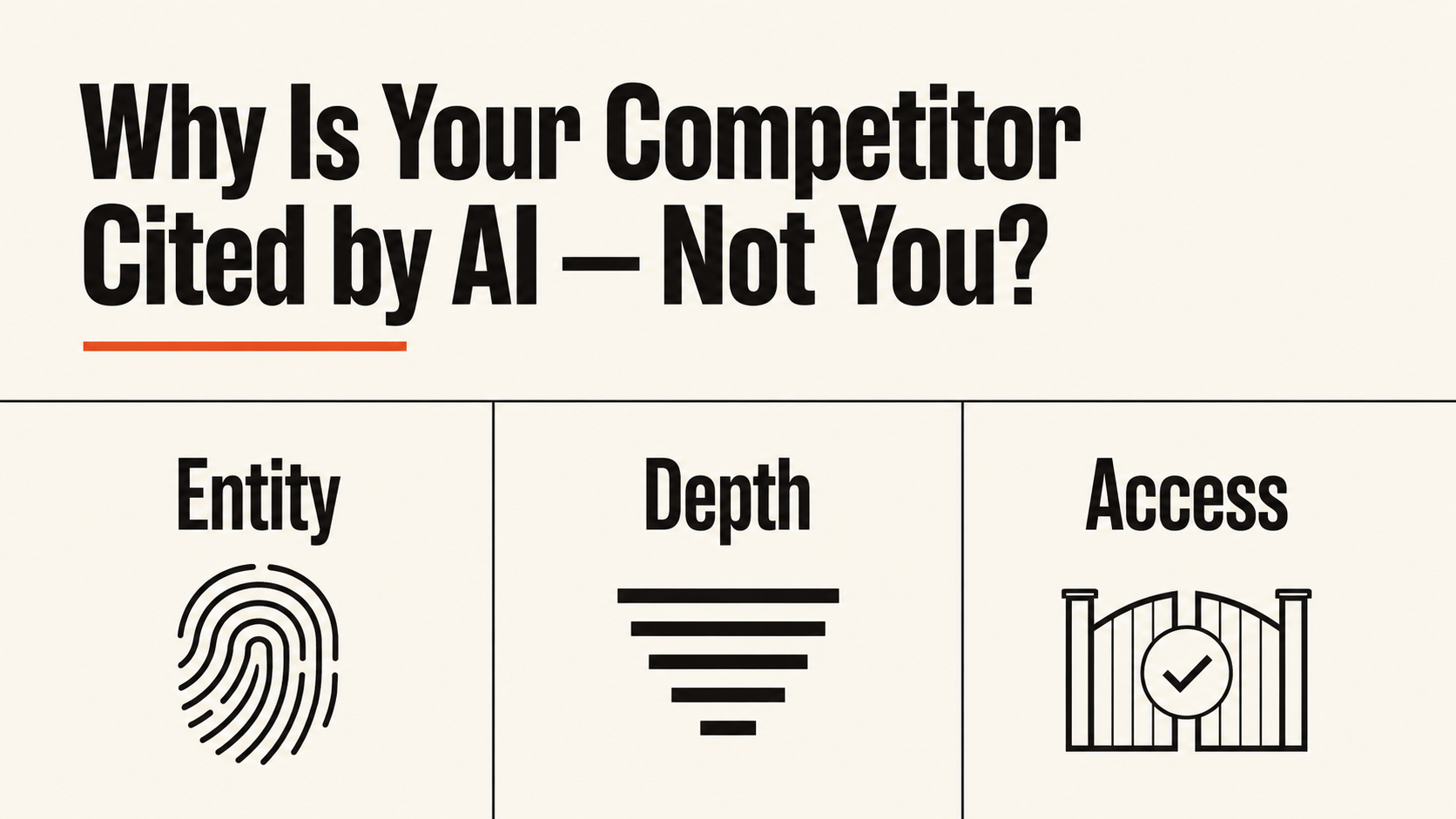
Your competitor is being cited because of one of three specific gaps: they’re a more clearly recognized entity, their cited page is structurally deeper, or your site blocks the crawler theirs allows. It’s rarely about content quality alone, and it’s not brand size. This audit tells you which gap is yours.
The Three Reasons a Competitor Gets Cited Instead of You
Here’s the myth to drop first: AI systems don’t have a bias toward established brands. Retrieval systems don’t know your Domain Rating or your headcount. Google has been explicit that its generative AI search features are rooted in the same core ranking and quality systems as regular search, not a separate layer that rewards size [Google Search Central, 2026]. If a five-person startup’s page answers a query more cleanly than an enterprise’s, the startup gets cited.
So the actual causes sort into three buckets:
- Entity recognition differential. The competitor’s brand, product names, and author are consistently and unambiguously identified across the web — schema, bios, consistent naming. The retrieval system knows who they are. Yours is fuzzier.
- Content depth differential. Their cited page answers the question more completely — more structure, more specificity, an actual direct answer near the top. Yours makes the reader work for it.
- Crawl access failure. The bot that would fetch your page for that platform is blocked. It doesn’t matter how good the page is if the crawler never reaches it.
Treat these as mutually exclusive diagnoses, not a checklist to fix all at once. If you spend three months building topical authority when the real issue is a blocked crawler, you’ve spent three months solving the wrong problem — and the crawler is still blocked. That’s the cost of guessing instead of auditing.
Step 1: Map Where Your Competitor Is Actually Cited
Before diagnosing anything, confirm the citation is real and find out where it’s happening. Don’t start from your competitor’s keyword rankings — start from natural-language queries, phrased the way a buyer would actually ask.
Run your competitor’s core terms as full questions, not fragments:
- In Perplexity, ask the question directly and note which URL the answer cites — not just whether the brand is mentioned in passing.
- In ChatGPT (with browsing/search on), ask the same question and check the source list.
- In Google AI Mode, run the same query and record which pages the overview draws from.
Log three things per platform: the cited URL, the exact query that triggered it, and whether your own domain appeared anywhere in the response — cited, mentioned, or absent entirely. Do this for your five to ten highest-intent keywords, not one. A single query is a data point; a pattern across ten is a diagnosis.
If you’d rather not run this manually every time, a keyword-driven tracker like llmrefs.com automates the query-and-log step across Perplexity, ChatGPT, and AI Overviews and will show you the pattern faster than manual spot-checks — useful once you already know the pattern exists and want to monitor it over time, less useful for the first diagnostic pass, which benefits from you reading the actual cited pages yourself.
Step 2: Analyze the Cited Pages for Three Signals
Once you know which of your competitor’s pages get cited, read them — actually read them, not skim the SERP snippet — against the three causes.
| Diagnostic Signal | What You’re Checking | Where to Check It | Root Cause If Present in Theirs, Absent in Yours |
|---|---|---|---|
| Entity terminology consistency | Do they use named, consistent terms for their product/framework across the page, their schema, and their about/author pages? Is their author a real, linked, credentialed person? | Page copy, Person/Organization schema (view source or a schema validator), author bio page | Entity recognition differential |
| Structural depth | Direct-answer paragraph near the top? Clear H2s phrased as questions? A comparison table or numbered steps where relevant? | Read the cited page top to bottom; compare word count and structure to yours on the same topic | Content depth differential |
| Crawler access | Is PerplexityBot, OAI-SearchBot, or Googlebot allowed in their robots.txt? Is yours? | [their-domain]/robots.txt and your own | Crawl access failure |
A few specifics worth knowing before you check that last row. Perplexity’s indexing crawler, PerplexityBot, is documented as not being used for model training — it’s there to build the index that powers cited answers, and it’s expected to respect robots.txt directives [Perplexity Crawlers documentation, 2026]. OpenAI splits its crawlers by function: GPTBot handles training, but OAI-SearchBot is the one that determines whether your page can appear in ChatGPT’s search results and citations — a site that blocks OAI-SearchBot won’t be shown in ChatGPT search answers, even if GPTBot is allowed [OpenAI Publishers and Developers FAQ, 2026]. These are two different opt-outs answering two different questions, and conflating them is one of the more common self-inflicted gaps we see.
Run your own robots.txt against both bot names before you conclude the gap is entity or depth. It takes ninety seconds and rules out the cheapest fix first.
Step 3: Match Your Diagnosis to a Root Cause — and Fix the Right One
Whichever signal showed up in their page and not yours is your root cause. Don’t average across all three; the audit is designed to isolate one.
If it’s entity recognition differential: the fix is consistency, not more content — an Entity Spine of matching schema, author credentials, and terminology across every page you publish. This is the foundation layer of Citation Architecture, our methodology for AI Citation Engineering, and it’s worth getting right before writing another word of content.
If it’s content depth differential: restructure the cited-competing page specifically — a direct-answer paragraph at the top, question-phrased headings, the comparison table or steps a retrieval system can lift cleanly. For the mechanics of chunking a page so an AI system can extract it whole, this connects directly to answer-first content structuring.
If it’s crawl access failure: this is usually the fastest fix and the easiest to miss, because a blocked crawler produces the exact same symptom — silence — as a genuinely weak page. Before you touch a single sentence of content, verify your own crawl access directly rather than assuming your robots.txt is fine because nobody’s touched it in a year.
One more thing worth naming plainly: schema markup gets blamed for citation gaps more often than it deserves. It’s a real lever — but if you’ve correctly diagnosed entity or depth as your gap, schema alone won’t close it. Schema is one possible citation gap cause, not the default first fix for every symptom on this list.
Once you’ve run this audit on one competitor, run it on two or three more in the same category. A pattern that repeats across every competitor you check — say, they’re all consistently ahead on entity signals and you’re not — tells you more than any single comparison does.
This is also, not coincidentally, the audit our own AI Visibility Check runs automatically: query mapping across Perplexity and Copilot, cited-page signal analysis, and root-cause matching, without you manually reading robots.txt files at midnight.
When we ran this exact three-signal audit against our own site in June 2026 — before ideapreneur.io’s first confirmed citation — crawl access was clean and entity signals were thin: inconsistent author attribution across early pages, no Person schema yet. The entity gap, not a crawl gap, turned out to be the one that mattered here. That’s a sample of one, worth watching rather than banking on as a rule for every domain.
FAQ: Competitor AI Citation Gaps
Why does my competitor appear in AI answers and I don’t?
Often one of three causes: AI retrieval systems recognize their brand and content as a clearer entity than yours, their cited page is structurally more complete, or a crawler your site blocks is one their site allows. These three causes are not additive — usually only one is doing the actual work, and the other two look fine on inspection. Run the three-signal audit above against the specific page that’s getting cited: check entity and schema consistency, read the page for structural depth, then check robots.txt last. Whichever signal is present in their page and missing in yours is the one to fix first, before you touch anything else.
How do I find out which AI platforms cite my competitor?
Run your competitor’s core keywords as natural-language questions directly in Perplexity, ChatGPT with browsing on, and Google AI Mode, then record which URL each platform cites for each query — not just whether the brand gets a passing mention. Do this across five to ten high-intent keywords, not one, since a single query is a data point and a pattern across ten is a diagnosis. Log the exact query, the cited URL, and whether your own domain appeared at all: cited, mentioned, or absent. A tracking tool like llmrefs.com can automate this query-and-log step once you’ve confirmed the pattern manually, which is worth doing for your first pass since it forces you to actually read the cited pages.
Can I analyze competitor AI citation patterns?
Yes — the cited page itself is public, so you can read it directly against three diagnostic signals: entity terminology and schema consistency, structural depth (direct-answer placement, heading structure, whether it uses tables or numbered steps), and crawler access via their robots.txt file. None of this analysis requires special tooling for a first pass; a browser tab and their published robots.txt are enough to run the full audit manually. Where a tracker earns its keep is scale — checking this pattern across ten competitors and dozens of queries a month, rather than one comparison done once. Start manual, then decide if the volume justifies automating it.
Does robots.txt alone explain most AI citation gaps?
No, but it’s the fastest cause to rule out, and it’s the one most often skipped because a blocked crawler produces the exact same visible symptom — you’re simply absent from the answer — as a genuinely weak or thin page. Check PerplexityBot and OAI-SearchBot access specifically before assuming the cause is content quality; both are documented to respect robots.txt, and blocking either one removes you from that platform’s citations regardless of how good the page underneath is. In practice, a clean robots.txt is the easiest thing to rule out first, precisely because it’s binary — either the crawler is blocked or it isn’t. Entity and depth differentials are harder to diagnose and more often the actual cause, which is why the audit checks all three instead of stopping at the easiest one to verify.
How long does it take to close an AI citation gap once you’ve diagnosed it?
It depends which of the three causes you’re fixing. Crawl access failures resolve fastest — both Perplexity and OpenAI note their systems reflect robots.txt changes within roughly a day, so once you unblock the right crawler, the next crawl pass can pick up the change. Entity and depth fixes take longer, because they depend on the platform re-crawling and re-evaluating the page, not a fixed timeline anyone can promise a client. A realistic expectation is weeks, not days, for entity and depth corrections to show up as a citation change, and even then it’s tied to how often that platform re-indexes your specific page rather than a guaranteed schedule.
If you’re staring at a competitor’s cited page wondering which of the three gaps is yours, start with the audit above on your five highest-intent keywords. Whichever signal repeats across every comparison is the one worth fixing first — not the one that’s easiest to talk yourself into. Start with a Citation Architecture audit →
If crawl access checks out clean and the gap still isn’t closing, the upstream constraint is usually the same one this entire cluster keeps circling back to — AI systems that may struggle to resolve your brand as a distinct entity (our hypothesis; not vendor-documented) skip your content regardless of how deep or fresh it is. That foundation is the Entity Spine.
Find out which of the three citation gaps is yours.
Run Free Check →