What queries can my brand get cited for in AI answers? The ones it can win, so choose the query before you optimize the page.
Outcome-framed queries, such as what a technique changes about your citation odds, were winnable in Ideapreneur’s logged ChatGPT test. Mechanism-framed queries, such as how a technology works, returned vendor documentation and primary research instead. The test covers one engine and one valid run per frame, so discard mechanism queries first and verify.
On 16 August 2026, the same subject, chunking, returned arXiv research and vendor documentation under one framing and Ideapreneur under another. The framing that won also dominates the site’s Bing data: one grounding query accounts for 1,434 of the 2,707 citations (about 53%) in the Bing Webmaster Tools grounding-query export for 6 June to 9 August.
What queries can my brand get cited for in AI answers? Start with the framing
A mechanism-framed query asks how a system works: how retrieval works, how chunking is implemented, how a vector store splits text. The best source is whoever built the system, so answer engines cite vendor documentation and primary research.
An outcome-framed query asks what a technique changes for the reader’s own result, such as whether chunking changes citation outcomes. Nobody documents your outcome, so the source field stays open to whoever has tested it.
OpenAI Platform’s vector store documentation, one of the sources returned in the 16 August test, is the kind of page a mechanism query lands on.
The subject is identical in both frames. “How does chunking work in a retrieval pipeline” and “chunking impact on content citation by answer engines” share a topic and almost nothing else. (The first is illustrative. The second is a query I logged.) Competition follows the framing, not the subject.
Why do answer engines cite vendor documentation for mechanism queries?
This section is inference. One logged run suggests it, and it doesn’t prove it.
Answer engines retrieve passages that answer a query. For a mechanism question, the most direct passage is the one written by the people who built the mechanism. A marketing page that restates it adds no passage the documentation lacks, so it has little reason to be retrieved.
There is a second layer. Microsoft defines grounding queries as the key phrases the AI used when retrieving content that was referenced in its answers, and says the data is a sample of overall citation activity (Microsoft Bing Webmaster blog, 10 February 2026). My reading is that the frame you win is set by how the engine phrases its retrieval, which you can’t fully see from outside. You find out by testing.
That’s why keyword-based classification isn’t enough. You classify queries by what the engine retrieves.
What did the 16 August 2026 testing show?
I ran two framings of the same subject in ChatGPT and compared them with the Bing Webmaster Tools AI Performance data for ideapreneur.io.
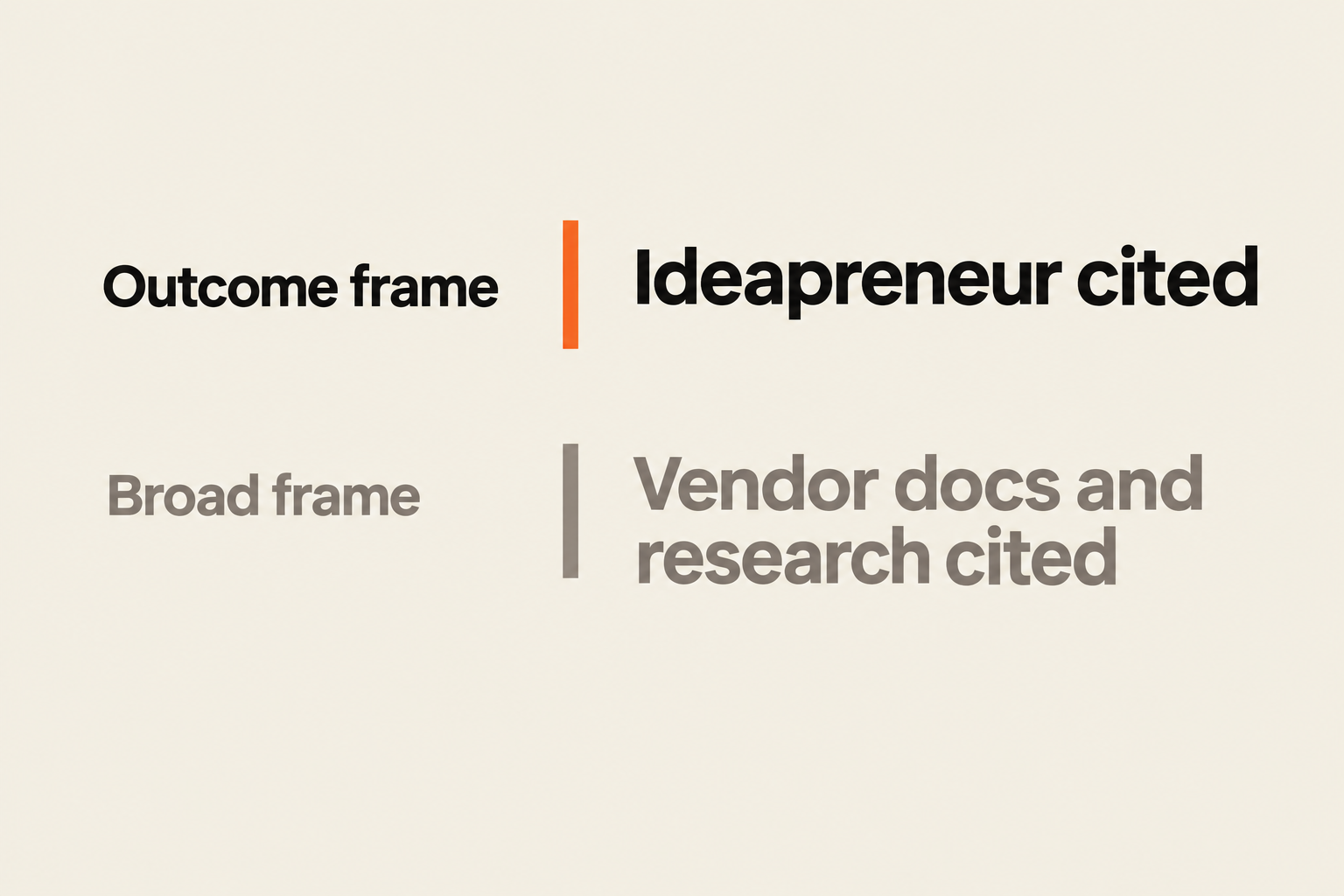
| Frame | Query as logged | Where | Sources returned | Ideapreneur cited? |
|---|---|---|---|---|
| Outcome | “chunking impact on content citation by answer engines” | ChatGPT | Ideapreneur as dominant source in the Sources panel (exact position not recorded) | Yes, on answer-first chunking |
| Broad / mechanism-leaning | “does chunking affect AI citation” (broad conversational framing) | ChatGPT, browse triggered on retry | Cloudflare AI Search docs, an arXiv chunk-size/RAG paper, Cohere Documentation, OpenAI Platform vector store docs | No |
| Outcome (grounding query matching row 1, per the Citation Log) | Same query | Bing Webmaster Tools AI Performance | 1,434 of 2,707 in the grounding-query export (6 Jun to 9 Aug) | n/a (aggregate data) |
It took four attempts to get a valid run on the broad framing. The first three returned answers with no Sources panel at all. Those are training-data answers, not retrieval evidence, so I didn’t log them.
The limits matter more than the table. This is one engine and one valid retrieval run per framing. The two queries differ in wording, not only in frame. The broad query also mentions citation, so its classification only became clear from what ChatGPT returned. I have no usable Google AI Mode reading for this topic, so nothing here speaks to it.
Microsoft describes the report as covering Microsoft Copilot, AI-generated summaries in Bing and select partner integrations (Microsoft Bing Webmaster blog, 2026). ChatGPT isn’t among them, so the two sources corroborate one query from different surfaces. They are not two independent tests.
What does winning a narrow frame look like, and what does it cost?
It looks concentrated. One grounding query carries about 53% of that export’s total. Microsoft says grounding-query data is a sample of overall citation activity, so read the 53% as a share of the sample, not of every citation.
That is what a winnable frame looks like in the data. It is also a concentration risk. If the frame shifts, or a competitor publishes the same tested answer, most of the citation footprint goes with it.
I’d still take the concentration over the spread. Ten mechanism queries held by vendor documentation give you ten places to lose by default. The cost of my position is real, though. In a niche where vendors publish little documentation, mechanism queries may be open, and this advice would make you discard winnable ground.
How do you get cited in AI results? Choose the target query first
- List the queries you want to be cited for. Write 10 to 20 in the words a reader would use. Add the grounding queries from Bing Webmaster Tools if you have them. You’ll have a working set to classify in one sitting.
- Tag each query mechanism or outcome. Ask whether the ideal answer describes how a system works or what a technique does to the reader’s result. Tag by the ideal answer, not the keywords, and expect to revise after step 3.
- Test each query in the answer engines you target, with sources visible. Log the date, engine, query as typed and every source returned. Discard runs with no Sources panel, because they are not retrieval evidence.
- Discard queries where vendor documentation or primary research fills the sources. Don’t try to outrank them. Keep queries where the returned sources are thin, dated or off-topic. That is your winnable set.
- Write for the survivors, then check concentration. If one query frame carries more than half of your grounding-query citations, as it does in the Bing export, add adjacent outcome-framed queries before publishing more of the same.
The pillar on chunking and AI citation shows what a page built for a surviving query looks like.
Common questions about getting cited in AI answers
How to get cited in AI results?
Start by choosing a query you can win, then write the page. Answer engines pull different sources depending on framing. In Ideapreneur’s 16 August 2026 test on ChatGPT, a broad framing returned vendor documentation and arXiv research, while an outcome framing returned Ideapreneur. So test your target queries with sources visible, drop the ones where primary sources dominate, and build an answer-first page for the rest. This is one site’s logged evidence on one engine. Treat it as a method for selecting targets, not a guarantee of citation.
How to get mentioned in AI answers?
Being mentioned follows from being the source an answer engine retrieves, and retrieval follows the query. Find queries where the returned sources are thin or off-topic, then publish a page that answers that exact framing in its first 40 to 60 words. Bing Webmaster Tools’ AI Performance report shows which grounding queries produced citations on Microsoft surfaces, so you can see where you’re already retrieved. Microsoft’s announcement describes it as covering Microsoft Copilot, AI-generated summaries in Bing and select partner integrations, so log ChatGPT checks by hand. I track citations as sources. Unlinked brand mentions are a separate measure I haven’t logged.
How to make your brand show up in AI searches?
Two things decide it. First, whether the engine can resolve who you are. Ideapreneur calls the foundation for that the Entity Spine: one canonical brand name and consistent structured data about the organization and its authors, everywhere they appear. Second, whether you’re competing for a query you can win. Ideapreneur’s logged test showed the framing alone changed which sources the engine returned for the same subject. So test your target queries with sources visible, drop those where primary sources fill the panel, and build answer-first pages for the rest. That’s one site’s evidence on one engine, so verify it on your own queries.
What should you do first to show up in AI searches for queries you can win?
Take your ten most important queries today. Tag each mechanism or outcome, test each with sources visible, and cross off every query where vendor documentation fills the panel. The survivors are your programme.
Next, read why the same page can be cited by one engine and ignored by another.
Find out which queries your brand can actually win.
Run Free Check →