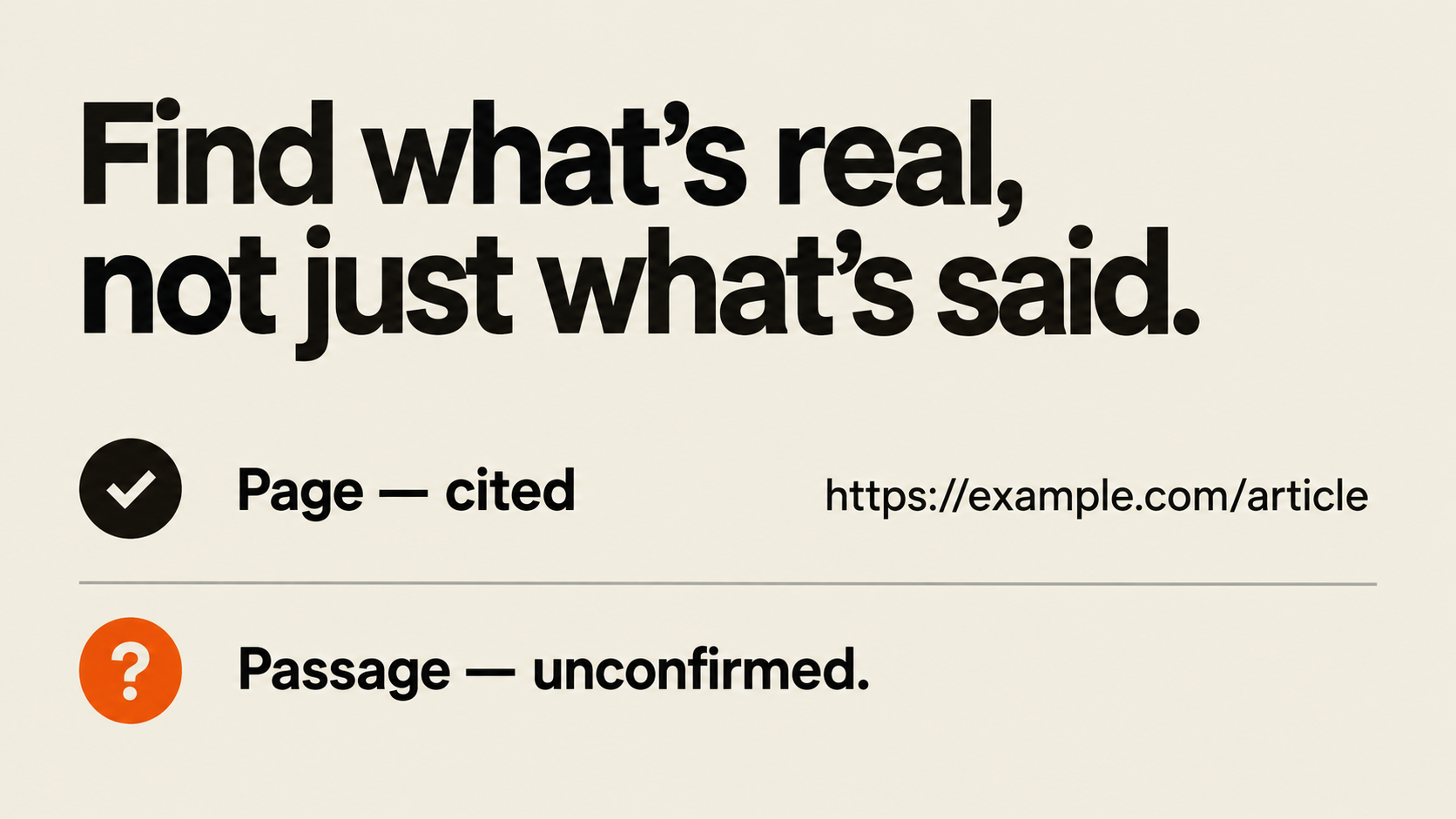
You want one number: which of your pages is AI citing, and how do you know it actually happened. Here it is, upfront.
Bing Webmaster Tools and Google Search Console each now show which of your pages appear in AI answers — Bing at the citation level, Google at the impression level. Neither confirms the exact passage used, neither covers competitor engines like ChatGPT, and neither replaces testing the actual query yourself.
What Bing’s Dashboard Shows You
Microsoft shipped AI Performance inside Bing Webmaster Tools on February 10, 2026, as a public preview — the first free, first-party dashboard from a major search platform built specifically to show publishers how their content appears in AI-generated answers.
Four original metrics: Total Citations (how many times any of your pages showed up as a source, in a date range you set), Average Cited Pages (the daily average of unique URLs from your site that appeared), Grounding Queries (the phrases the AI used internally to retrieve your content — not always what a person actually typed), and page-level activity over time.
Grounding query — the internal query an AI system generates to retrieve content from an indexed source, distinct from what a person typed into the chat interface. Bing exposes these because they’re the closest first-party signal to why a page got pulled. They say nothing about which sentence got used once it was.
On June 16, 2026, Microsoft added four more layers: Intents (grounding queries classified by intent — Informational, Commercial, Research, and similar buckets), Topics (queries grouped into themes), Citation Share (your percentage of citations for a given query, relative to whoever else got cited), and Compare (a prior-period overlay). That’s a real jump — from citation counter to something closer to competitive intelligence.
What It Explicitly Does Not Tell You
Here’s the part the vendor blog posts don’t lead with.
Microsoft states, in its own documentation, that Total Citations highlights how often content is referenced “without indicating placement or presentation within a specific answer.” Average Cited Pages carries the same caveat: aggregated across surfaces, so it “does not indicate ranking, authority, or the role of any page within an individual answer.”
That aggregation cuts deeper than it sounds. AI Performance covers Microsoft Copilot, AI-generated summaries in Bing, and “select partner integrations” Microsoft has never named — combined into one number. You cannot pull Copilot citations apart from Bing AI-summary citations inside the same report. Not exhaustive, either: grounding queries are sampled, not a complete log. And the coverage stops at Microsoft’s own ecosystem — ChatGPT, Perplexity, Gemini, Claude, and Google’s AI Overviews and AI Mode are simply absent. This is a Bing report. Treating it as a proxy for total AI visibility is the first mistake most GEO reporting makes.
What Google Search Console’s Generative AI Reports Give You
Google ships two separate dedicated reports here, not one combined view. The Generative AI performance report for Search — live worldwide since August 31, 2026 — covers AI Overviews and AI Mode. A distinct Generative AI performance report for Discover covers generative AI features in Discover. They live as separate tabs inside Search Console, not one merged dashboard, though both share the same shape: impressions broken down by page, country, and device, grouped by day, week, or month.
What neither includes, by Google’s own documentation: click data or query-level data. You can see that a URL appeared inside an AI feature and where in the world it appeared — you can’t see what someone typed to trigger it, or whether they clicked through. Google has said only that it’s “continuing to work with website owners” on which additional metrics might come next, without committing to a timeline.
The rollout itself is no longer a live caveat — Google confirmed worldwide availability as of August 31, 2026 — but a data-volume one still applies: you won’t see the report at all if your site hasn’t received enough impressions in generative AI features to populate it.
The older workaround still matters, because it covers a gap neither report closes. When someone clicks through from an AI Overview, Google sometimes appends a #:~:text= fragment to the destination URL — a browser instruction to scroll to and highlight the passage that was cited. It’s the nearest thing to passage-level evidence either platform offers, and it’s still unreliable: more common on long-tail queries, not guaranteed on every click, and shared with Featured Snippets and People Also Ask. The dedicated reports and the old fragment trick answer two different questions — did it appear, and did anyone click — and neither answers the one question everyone actually wants: which sentence got used.
Why Passage-Level Citation Attribution Is Currently Unobservable
Put the two platforms side by side and the gap in the market’s messaging gets obvious fast.
| Capability | Bing Webmaster Tools | Google Search Console |
|---|---|---|
| Names the cited URL | Yes, page level | Yes, page level, via two separate reports |
| Isolates one AI surface | No — aggregated | No — AI Overviews and AI Mode combined in the Search report |
| Shows which passage was used | No | No — #:~:text= fragment is a separate, unofficial signal |
| Shows clicks | No | No, by Google’s own confirmation |
| Coverage | Copilot, Bing AI summaries, unnamed partners | AI Overviews + AI Mode; Discover (separate report) |
As of September 2026, neither platform reports at the chunk or passage level — neither confirms passage-level retrieval, only that a page was used somewhere — because neither was built to. This is also why treating chunk-level content structure as something a citation dashboard will validate for you gets the causality backwards — how you chunk content may influence whether you get cited at all, but no report will confirm it worked at the passage level.
Vendors selling a “chunk-level citation score” or a “passage attribution report” are inferring from proxies — click patterns, fragment appearances, position-one assumptions — and presenting the inference as a measurement. Ask what it’s built on before you pay for it. In most cases the honest answer is: nothing a platform vendor has confirmed.
How to Test It Yourself: A Query-Logging Method
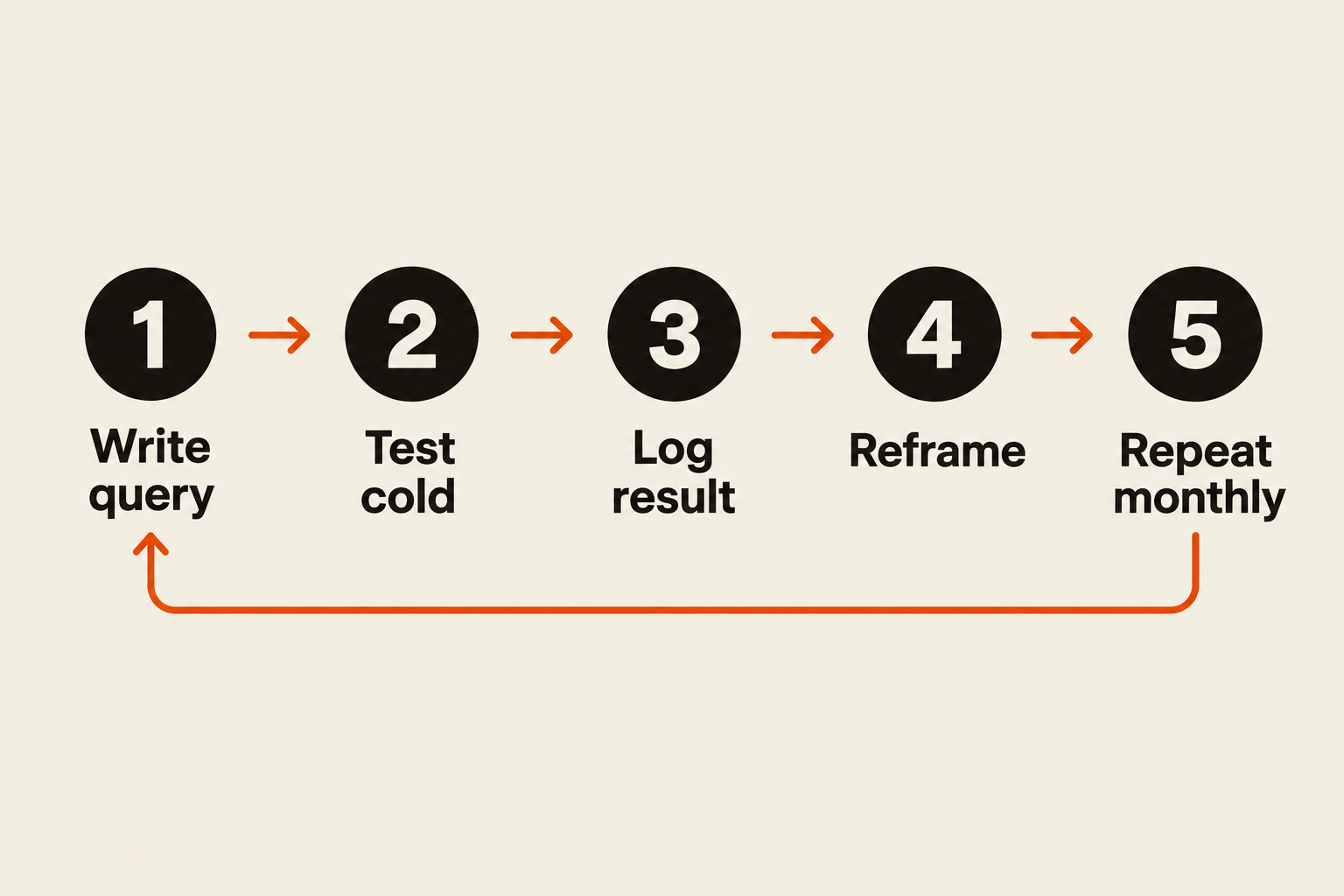
- Write the exact question a buyer would ask — not your target keyword. “Best CRM for a 10-person agency,” not “CRM software.” AI engines retrieve against natural language, not head terms.
- Run it cold, in every engine you’re tracking — ChatGPT, Perplexity, Copilot, Google AI Mode. Check for an actual citation, a linked or named source, not a brand mention.
- Log four things, every time: engine, date, exact query text, cited or not. Log “not recorded” as its own data point when position isn’t shown — that gap is information too.
- Re-run the same topic with a different framing before drawing any conclusion — broader, narrower, more technical, more conversational.
- Repeat monthly, dated. One test is a data point. A dated log across months is the closest thing to Bing’s Compare feature you can build yourself.
Here’s what that looked like on our own site, logged August 16, 2026. Bing’s export for the window June 6–August 9 showed one query about chunking’s effect on AI citation — logged verbatim as “chunking impact on content citation by answer engines” — carrying 1,434 of 2,707 total citations for the period, a 21% citation share. We ran the identical framing cold in ChatGPT the same day; ideapreneur.io came back as the dominant source in its Sources panel, corroborating the Bing number independently. Exact position within that panel wasn’t recorded, just presence. Then we tried a broader framing of the same underlying idea — loose RAG-mechanics language instead of a citation-outcome question — and it returned nothing. Three attempts, no Sources panel at all. Same topic, different framing, opposite result.
Your Google export adds a third, non-comparable data point. Ideapreneur.io logged 564 total impressions across AI Overviews, AI Mode, and Discover between late May and mid-September — climbing all year: 62 in June, 163 in July, 163 in August, already 176 in the first half of September. Bing’s citation volume, over the same window, peaked in late August and fell roughly 97% into September on the same site. Two platforms, two directions, same window. That’s not one number contradicting another — it’s confirmation that “AI visibility” isn’t one metric, and a report from either platform only ever describes its own house.
The page-level detail cuts the same way. The page that carried 53% of Bing’s query-file citations and was confirmed independently on ChatGPT — chunking’s effect on AI citation — shows just 8 impressions in Google’s entire AI-feature export for the same period. Meanwhile core pages like /architecture (194 impressions) and /information-gain (152) lead Google’s list without registering the same way on Bing or ChatGPT. Same site, same window, different winners on every platform — the cited by one AI engine and ignored by another pattern, in real exported data, not a hypothetical.
The site-wide numbers above are pulled directly from Bing and Google exports dated September 17–18, 2026 — current as of publish. The single-query figure (1,434 of 2,707 citations, 21% share) is still sourced from an August 16 manual log entry, not a fresh query-level export — that breakdown isn’t available from either file provided, so it stays labeled as a dated log entry rather than a verified current number.
Frequently Asked Questions
How do I find out if AI is citing my website?
Verify your site in Bing Webmaster Tools and check the AI Performance report — free, and the most detailed first-party dashboard, naming which pages get cited across Copilot, Bing AI summaries, and unnamed partner surfaces. Google Search Console now offers two comparable but narrower views: separate Generative AI performance reports for Search (AI Overviews and AI Mode) and Discover, live worldwide as of August 31, 2026 — impressions only, no clicks, no query data. For ChatGPT, Perplexity, and other engines, there’s still no dashboard at all: run your own queries, check whether your page comes back as a linked source, and log the result with the date.
Can I see which paragraph AI quoted from my page?
No public tool confirms this directly. Bing’s AI Performance report states outright that it doesn’t indicate placement or role within a specific answer — page-level citation only. Google’s dedicated Generative AI performance reports (live worldwide since August 31, 2026) have the same ceiling: they show which pages appeared, not which passage was used, and carry no click or query data at all. Google’s closest signal to an actual passage is the #:~:text= URL fragment, which sometimes appears when someone clicks through from an AI Overview and highlights the passage used on your page — but it’s inconsistent, more common on long-tail queries, not guaranteed on every click, and shared with Featured Snippets and People Also Ask.
Does Bing Webmaster Tools show citations from ChatGPT or Perplexity?
No. AI Performance covers Microsoft Copilot, AI-generated summaries in Bing, and select partner integrations Microsoft hasn’t publicly named — it has no visibility into ChatGPT, Perplexity, Gemini, Claude, or Google’s AI Overviews and AI Mode. Even within its own coverage, the report aggregates Copilot and Bing AI summaries together, so you can’t isolate one Microsoft surface from another, let alone see a competing engine.
Does Google Search Console show which pages get cited in AI Overviews?
Yes, since August 31, 2026, worldwide — but as two separate reports, not one. Google’s Generative AI performance report for Search covers AI Overviews and AI Mode; a distinct report covers Discover’s AI features. Both show which pages appeared, broken down by page, country, and device, grouped by day, week, or month. No click data and no query-level data — you can see that a page appeared but not what was searched or whether anyone clicked through.
How reliable are Bing’s grounding queries?
Reasonably informative, not exhaustive. Microsoft states AI Performance data is aggregated and summarized to provide a representative view, not a complete log of every retrieval event — grounding queries are sampled, and most grounding events never surface as a visible citation at all. Treat what the dashboard shows as directional rather than a full accounting of every time your site was used. The fastest sanity check is manual: take a handful of your top-reported grounding queries and run them by hand, directly in Copilot, to confirm your page still appears the way the dashboard suggests it does.
We log every one of these checks the same way — engine, date, exact query, cited or not — and this piece gets updated as that log grows.
Find out which Citation Architecture signals your content is missing.
Run Free Check →