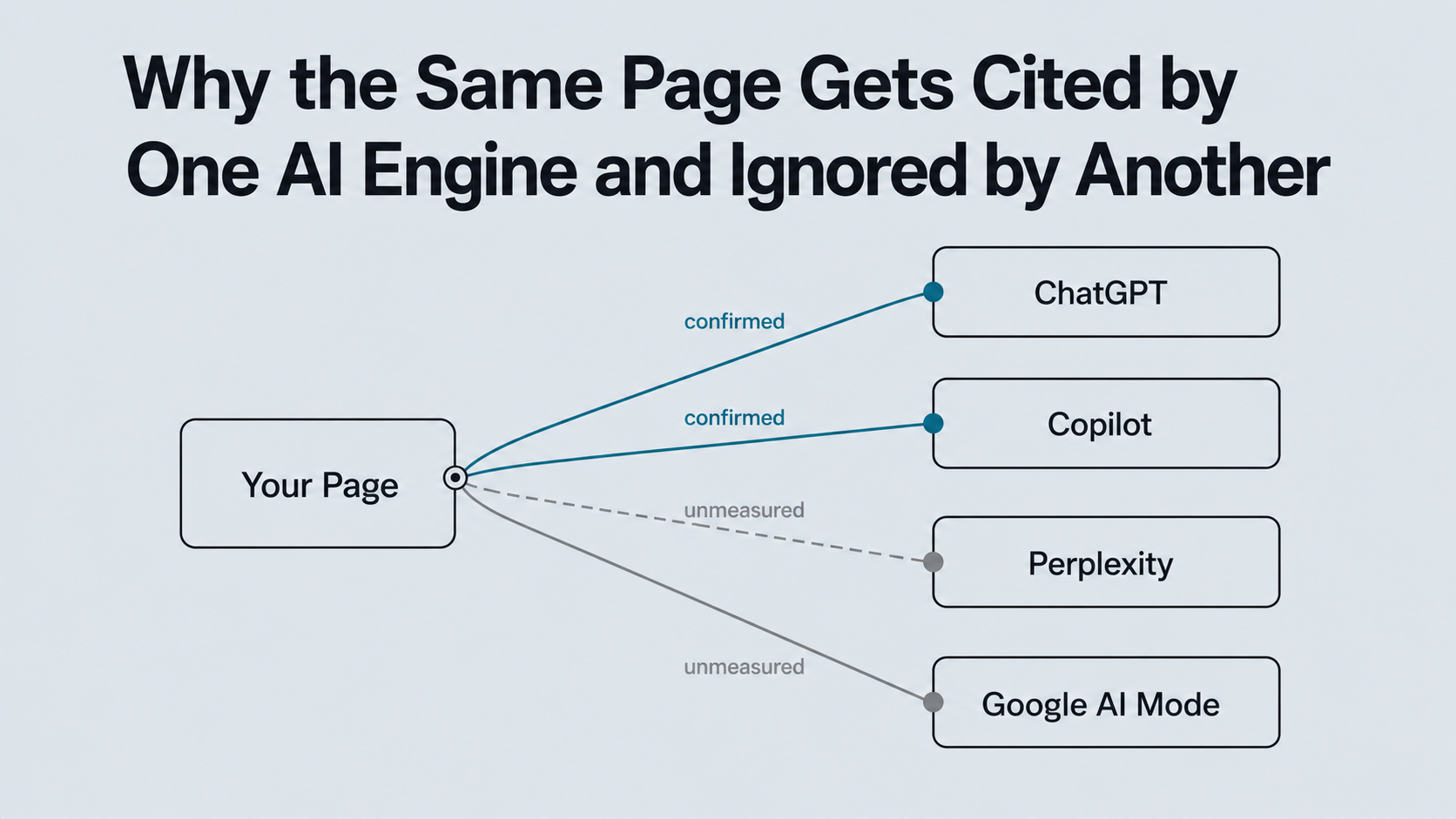
One of our articles is cited on two AI engines right now. On a third, we have no data at all. Both of those things are true today, about the same page.
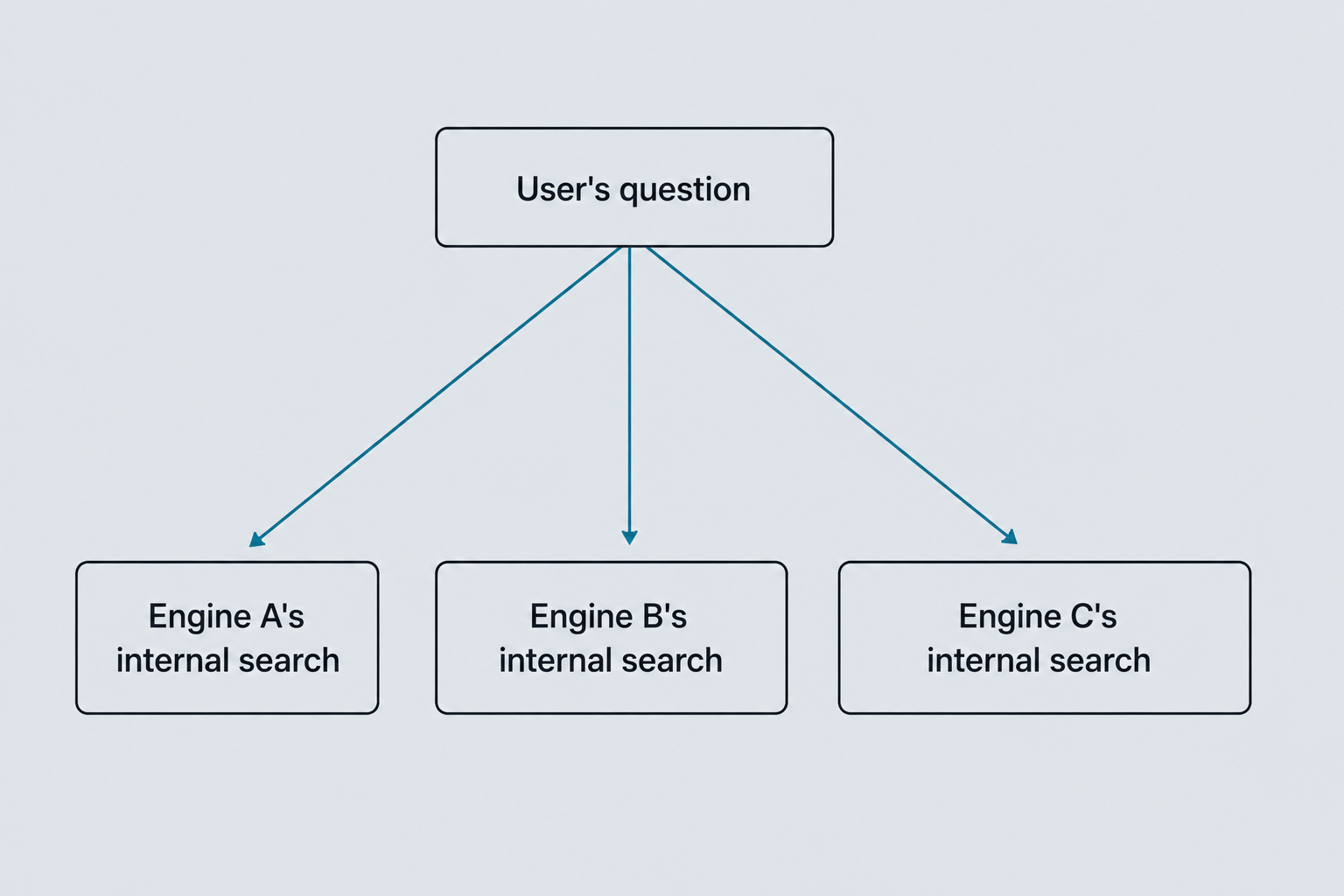
A page gets cited by one AI engine and not another because each engine runs its own retrieval index, rewrites the user’s query into different search terms before it goes looking, and grounds its answer against a different slice of the web. Divergent citation results across ChatGPT, Copilot, Perplexity, and Google AI Mode reflect engine architecture — not a quality problem with the page.
Here’s the evidence, plainly stated before anything else: the page in question carries an 11.27% citation share on Bing’s AI Performance report for its primary grounding query, per the 31 Aug 2026 export (data spans 6 Jun–29 Aug 2026) — 4,202 citations, more than half of the 7,211 citations logged site-wide across that entire window. Checked by hand on August 16, 2026, it also came back as the dominant source in ChatGPT’s Sources panel for the same underlying query. Perplexity: no data logged. That’s not a failure. It’s what an honest measurement looks like.
What Does It Mean When an AI Engine “Cites” Your Page?
“Cited” doesn’t mean the same thing twice. ChatGPT surfaces a Sources panel next to answers built with live web search. Perplexity attaches inline, numbered citations directly in the answer text. Google AI Mode links out beneath its generated summary. Microsoft Copilot draws on Bing’s index and shows citations inline — and Bing’s own Webmaster Tools reporting can’t fully separate a Copilot citation from other Bing-powered surfaces it also feeds. More on why that matters in a moment.
Citation share, as tracked in Bing Webmaster Tools’ AI Performance report, is the percentage of citations attributed to a given site out of all citations shown for one specific grounding query — a competitive visibility metric, not a raw citation count. It doesn’t tell you what ChatGPT or Perplexity are doing with the same page; it only tells you how you’re doing relative to whoever else is showing up for that exact query, on that specific report, in that specific window. Knowing which layer you’re actually measuring matters before you touch whether chunking changes citation outcomes or anything else downstream of it.
Why Do AI Engines Cite Different Sources for the Same Page?
Because they’re not reading from the same shelf. A grounding query is the internal search phrase an engine generates — often nothing like what the user typed — when it needs to pull live web content to answer a question. Different engines rewrite differently, search differently, and rank what comes back differently. This is the retrieval layer of Generative Engine Optimization: whether a passage from your page enters an engine’s context window at all, before ranking is even a question. Passage-level retrieval, not page-level ranking, is the unit these systems actually compete on.
The published research backs this up, and it’s louder than one page’s log. BrightEdge’s 2026 source-layer study found pairwise overlap in the top 100 cited sources ranging from 16% to 59% between engine pairs, while the brands those engines ultimately recommend cluster far more tightly — 36% to 59% overlap [BrightEdge, 2026]. The engines disagree substantially about where to pull information from. They agree more about who deserves to be in the final answer. Separately, Conductor tracked citation behavior across seven engines and seven intent categories for seven months — September 2025 through March 2026, 1,056 data points — and concluded each engine has developed what it calls a persistent “editorial identity”: ChatGPT Search favors citation-grade prose with named entities and structured summaries; other engines lean toward video, forums, or institutional sources instead [Conductor, 2026].
Most teams treat all of this as a single “AI visibility” score. It isn’t one, and chasing it as one is a mistake with a real cost: you’ll end up optimizing for the average of four different systems and satisfying none of them particularly well.
A Documented Split Result: One Page, Three Engines, One Unmeasured
On August 16, I ran the same grounding query through ChatGPT twice by hand, because the first result surprised me enough that I didn’t trust it. It came back the same both times: ideapreneur.io as the dominant source in the Sources panel, for a page I hadn’t expected to travel that fast. I logged it, dated it, and moved on — that’s the whole ritual.
No dashboard did this for me.
Here’s what the log actually shows for that one page, as of this writing:
| Engine | Citation Status | Evidence | Date |
|---|---|---|---|
| Bing-attributed surfaces (Copilot + partner) | Cited — 11.27% citation share (4,202 citations) | Bing WMT AI Performance export | 6 Jun–29 Aug 2026 |
| ChatGPT | Cited — dominant source in Sources panel | Manual check | 16 Aug 2026 |
| Perplexity | No data logged | — | — |
| Google AI Mode | No data logged | — | — |
| Claude / Gemini | No data logged | — | — |
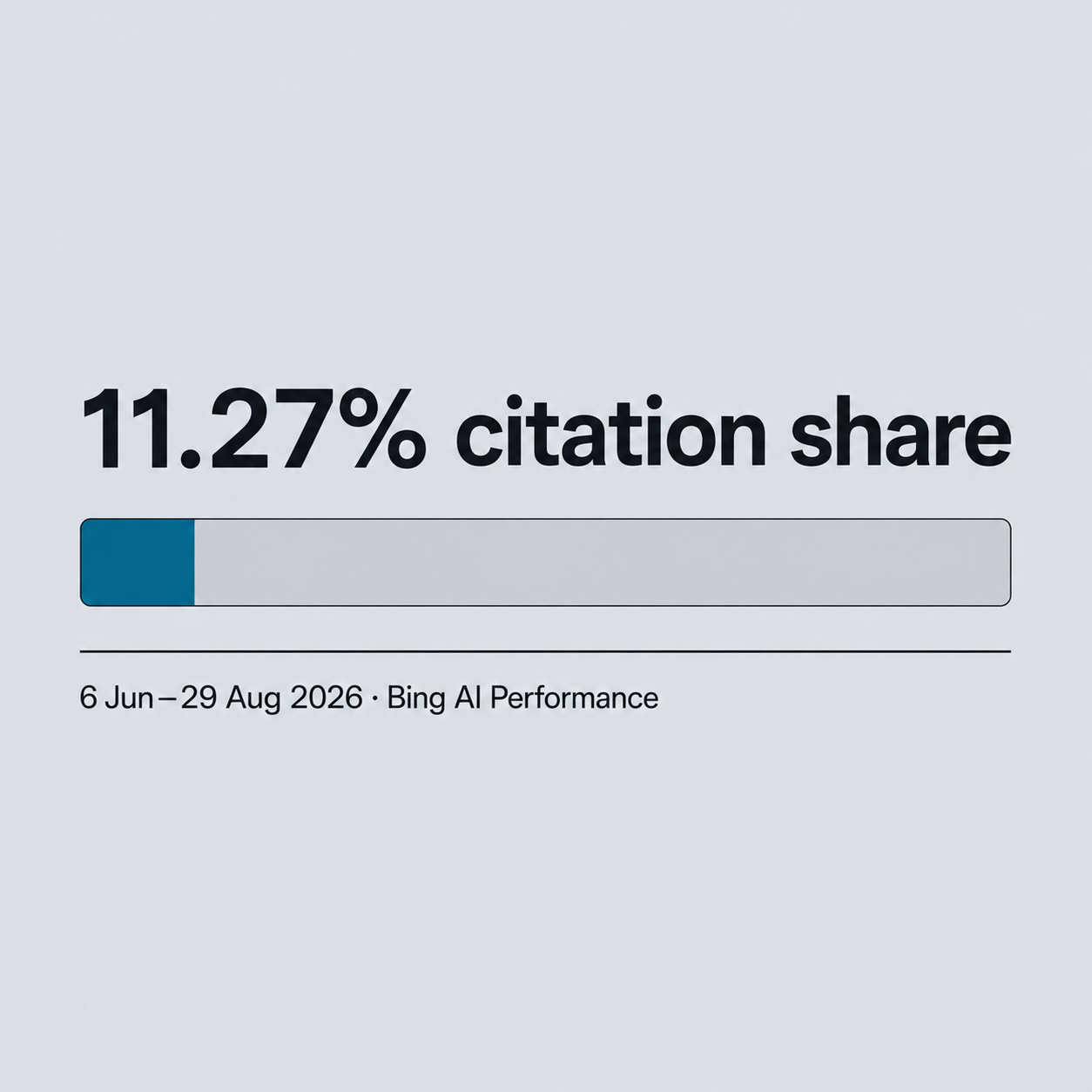
That 4,202-citation figure is one grounding query among several close variants Bing tracks for this topic — “impact of chunking on content citation by answer engines” pulls another 954 at an 18.36% share, and a dozen smaller phrasings trail behind it. We’re anchoring on the single largest, most literal phrasing here rather than summing the family, because summing near-duplicate query variants is exactly the kind of rounding-up move this article is arguing against.
That “no data logged” row for Perplexity is the part most GEO reporting glosses over. It is not a citation failure. It is an absence of a check. Those are different claims, and confusing them is exactly the failure mode this whole piece is arguing against — claiming coverage you haven’t actually measured is worse than admitting the gap, because it breaks the moment someone checks behind you.
One honest caveat, since we raised it earlier: Bing’s own AI Performance report can’t fully isolate a Copilot citation from other Bing-powered partner surfaces it also feeds. So even the “Cited” row above carries a footnote — it’s Bing-attributed, not Copilot-verified in isolation. We’re stating that limit here rather than rounding it away.
Is Google AI Mode Citing Itself More? What the PAA Box Is Actually Asking
This question shows up in Google’s own People Also Ask box for citation-related searches, and it deserves a straight answer: we don’t have a logged observation of self-preferencing behavior in our own data yet. Until we do, this stays an open industry question, not an Ideapreneur finding — and we’re not going to dress up an absence of evidence as a confirmed pattern just because it would make a punchier section.
What’s publicly documented is narrower. BrightEdge’s 2026 source-layer analysis found Google AI Overviews leans more heavily on user-generated content (18%) than several other engines, which use authority or editorial sources more heavily [BrightEdge, 2026]. That’s a sourcing-mix difference, not evidence of self-preferencing toward Google’s own properties. If you’re tracking this question for your own pages, log it the same way we logged the ChatGPT check above — dated, engine-specific, and separated from your other citation data. Don’t let one engine’s pattern quietly become “AI” as a category.
How to Read Your Own Cross-Engine Citation Split
- Pull your Bing Webmaster Tools AI Performance export. File → AI Performance → export the citation share and grounding-query data for your target page. You’ll get a percentage and a raw citation count against everyone else showing up for that query.
- Run the identical query, worded exactly the same way, through ChatGPT, Perplexity, and whichever other engines matter to your audience. Not a paraphrase — the same words. Screenshot or copy the Sources panel or inline citations.
- Log each result with the engine name and the check date, not just “cited” or “not cited.” A result from six weeks ago is not the same claim as a result from this morning.
- Mark anything you haven’t personally checked as unmeasured, not absent. These are different words for a reason. Say so out loud in your own reporting, even when it’s less impressive than a clean scoreboard.
- Report the split, not an average. A dashboard that blends four engines into one score will always hide the exact information a founder-led buyer needs to see: which system found you, and which one still hasn’t looked.
If the structural question behind all of this is nagging at you — whether chunking changes citation outcomes at all, independent of which engine you’re measuring — that’s the deeper mechanics piece this one sits beside. And if you’d rather have this split run for you across your whole site instead of one page at a time, that’s exactly what our AI Visibility Check does.
FAQ
Why is my page cited by ChatGPT but not Perplexity?
Most often because the two engines run different retrieval systems entirely. ChatGPT rewrites your query into its own search terms and pulls from its own index; Perplexity does the same with different rewriting logic and a different index. A page can be a strong match for one engine’s retrieval pattern and simply never enter the other’s search results for that query — this is a routing difference, not a ranking loss. Check both engines with the identical query wording before concluding anything about content quality.
Does being cited on one AI engine mean I’ll eventually get cited everywhere?
Not necessarily, and don’t report it that way to a client or a boss. Citation on ChatGPT tells you ChatGPT’s retrieval and grounding process selected your page for that specific query, on that specific check date. It says nothing directly about Perplexity, Google AI Mode, or Copilot, which run independent processes. Track each engine separately and let the pattern — or the lack of one — emerge from actual checks, not from extrapolation.
How do I check which AI engines are citing my page?
Pull Bing Webmaster Tools’ AI Performance report for Copilot-and-partner-surface data, then manually query ChatGPT, Perplexity, and any other engine your audience uses — using the exact wording a real user would type, not a paraphrase. Log the engine name, the exact query, whether a citation appeared, and the date checked. No single dashboard currently covers all major engines at once, so a combined log is the only accurate picture available in 2026.
What is a grounding query?
A grounding query is the internal search phrase an AI engine generates for itself — often different from what the user actually typed — when it needs to retrieve live web content to answer a question. The engine searches for the grounding query, not your target keyword, which is why keyword-matching your page to a user’s original phrasing doesn’t guarantee retrieval. Understanding how an engine tends to rewrite queries in your topic area matters more than optimizing for the literal search term.
If you want to see this discipline run against your own pages instead of just this one case, start with a Citation Architecture audit →
Find out which AI engines are actually citing you — and which ones you haven’t checked yet.
Run Free Check →