Most writing about chunking and AI citation is asserted, not measured.
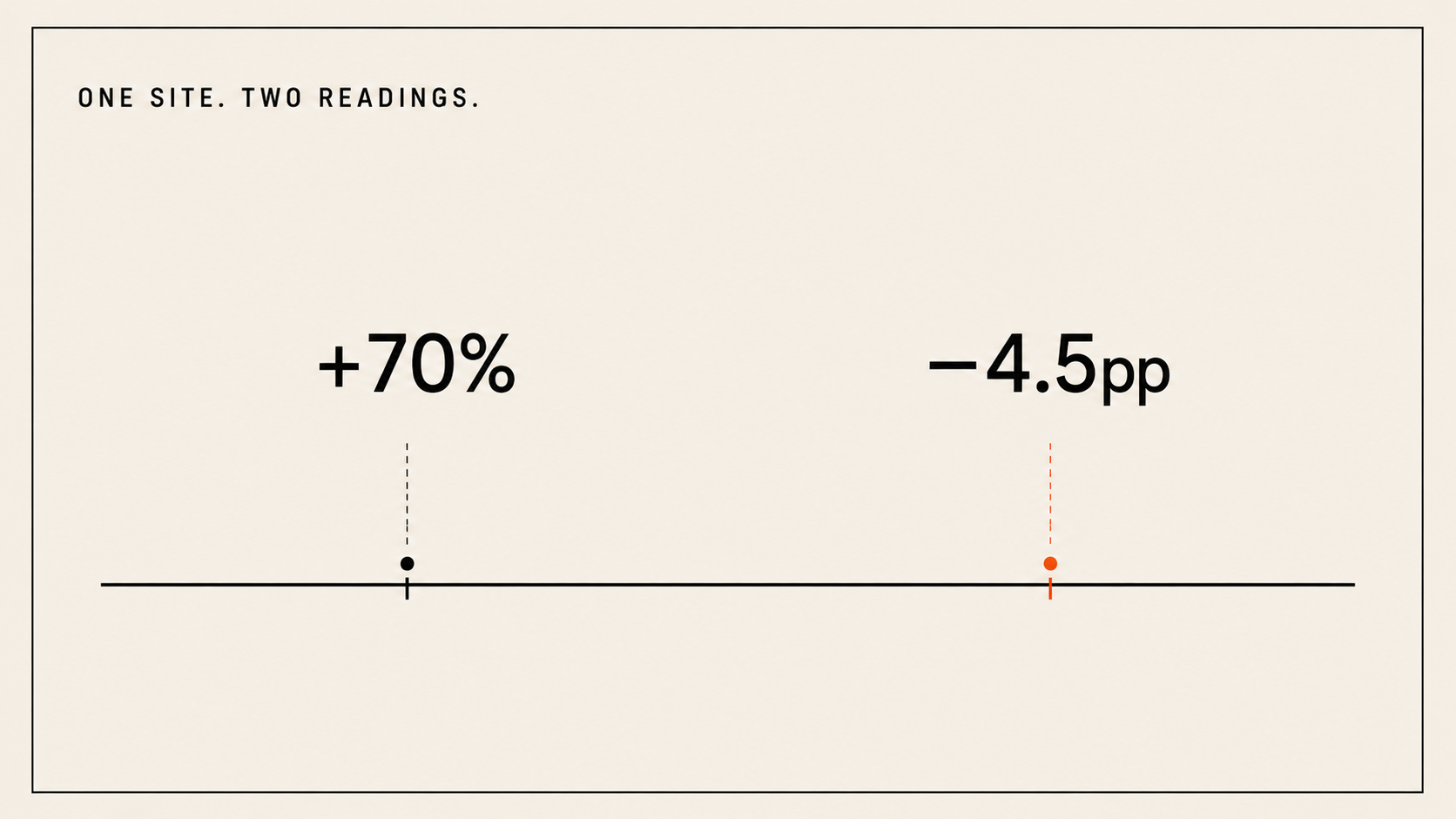
Yes — but not by itself, and not predictably. On this site, restructuring content into answer-first chunks lined up with a confirmed ChatGPT citation and a roughly 70% rise in Bing-tracked citations, alongside falling citation share and zero domain overlap between what ranks nearby and what gets cited.
That pattern held across a second dated reading taken 16 August 2026 — not just a one-off spike from the prior export.
What “Chunking” Means When People Say It Changes AI Citations
Chunking, in this context, means writing web content in self-contained sections — often 150 to 300 words — that each answer one question completely enough to be lifted out and used on their own. An answer engine practicing passage-level retrieval isn’t pulling a whole page into its response; it’s pulling a passage. A chunk that stands alone gets pulled. A paragraph that depends on the sentence before it usually doesn’t.
That’s the theory almost everyone agrees on. Where the agreement stops is whether doing it actually changes citation outcomes, or whether it’s a plausible-sounding structural fix that doesn’t move the number anyone actually cares about.
This page sits inside that argument, not outside it. It’s cited by ChatGPT for a version of this exact question, and it holds measured citation share on Bing’s tracked AI surfaces for a query where it doesn’t appear anywhere in the conventional top-10 search results. Two data points don’t prove a mechanism. They’re still more than most of what gets offered as evidence in this argument.
That ChatGPT citation is logged 16 August 2026 in our internal tracking, alongside the Bing citation-share reading for the same window — the full figures are in the next section, not held back for effect. It’s also the shape of a pattern this cluster runs into repeatedly: being cited by one engine and ignored by another is common enough that it deserves its own diagnostic — that piece is next in this cluster.
If you want the mechanics — how to structure a chunk, where headings should sit, how long each section should run — that’s covered separately in how to write answer-first chunks, which is currently the best-performing citation asset in this account. This piece stays on one question: does doing that change whether you get cited at all.
What We Measured on Our Own Site
We didn’t set out to measure the chunking impact on content citation by answer engines in the abstract. We set out to check one dashboard, twice, roughly two months apart, and report what changed — including the parts that didn’t go the way we expected. If you haven’t run that check on your own site, checking which of your own pages AI is actually citing is the place to start before trusting any lift percentage attached to your niche — that diagnostic is also queued next in this cluster.
Bing Webmaster Tools’ AI Performance report — which pools citation data across Microsoft’s AI surfaces rather than isolating any single one of them — showed 2,443 citations in the 16 August 2026 export, up from 1,434 in the prior reading, a rise of roughly 70%. Over the same window, citation share on the tracked query file fell from about 21.06% to 16.56%, a drop of roughly 4.5 percentage points, while the query file itself grew from 2,707 tracked queries to 3,902. Citations climbed. Share of the visible pie shrank. Both things happened at once.
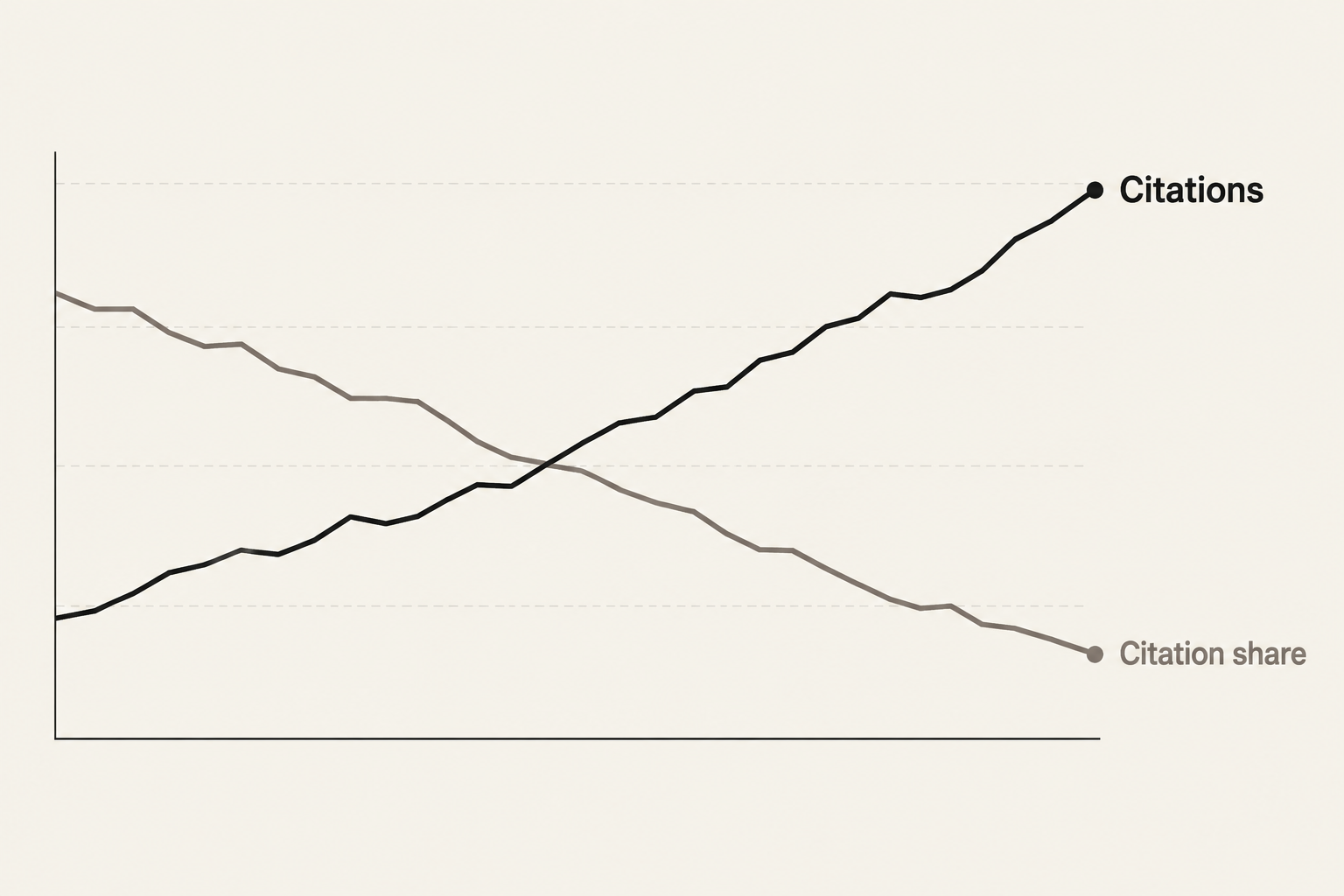
On 16 August 2026, we pulled that export specifically to check where the site’s chunked pillar on answer-first structure stood two months after publish. We expected the newer, more heavily chunked pages to broaden which topics got cited, not just how often. Instead, chunking-family queries went from 67.2% of the query file to 76.7% — narrower, not broader, even as raw citations climbed. That’s not the story we set out to tell.
Separately, on ChatGPT, this cluster holds a confirmed citation, logged 16 August 2026 in our internal citation log, for a query that returns no result at all in the conventional top-10. The page getting cited and the pages currently ranking are not the same competitive set — a pattern that shows up again, more starkly, later in this article.
The Case Against Chunking
Not everyone agrees chunking does anything. Prismic’s analysis of why content ranks on Google but doesn’t get cited by AI argues that the structural fixes marketers reach for first — chunking among them — were tested and didn’t move citation outcomes, and that the real gating factors sit elsewhere: entity clarity, source authority, and whether the answer engine trusts the domain at all before it ever gets to sentence structure.
That’s a fair objection, and nothing in this article fully answers it. Our data shows citation counts rising alongside a restructuring effort. It doesn’t isolate chunking as the cause, because nothing else about the site held still during the same period — entity spine work, schema markup, and internal link structure all changed too, on the same pages, in the same window. A single site with several simultaneous changes cannot cleanly attribute one outcome to one input. Anyone telling you otherwise — including an earlier draft of this piece — is overstating what a correlation on one dashboard can prove.
Treat this section as the floor under everything that follows: whatever chunking is doing here, it isn’t doing it alone, and it isn’t doing it fast.
The Case For Chunking
The competitive research behind this piece surfaced a 17.3% citation lift, a 2–4x multiplier, and a 65% improvement, each attached to chunking or answer-first structure, each from a different publisher, and none of them checked against each other. Ahrefs, Lumar, Frase, and Machine Relations each publish some version of this claim. None of them publish the competing numbers side by side, and none appear to be measuring quite the same outcome — citation frequency, citation share, and inclusion rate get used almost interchangeably across the set, which makes the numbers look more comparable than they actually are.
Lumar’s explainer is the more conservative case: it frames chunking as a prerequisite for extractability rather than a source of a specific percentage lift — a claim that’s harder to disprove and, on the evidence available, more defensible than the sharper numbers circulating elsewhere.
That’s the actual state of the evidence: multiple credible-sounding figures, no shared methodology, no adjudication between them, and no first-party instrumentation behind most of them that’s been made public. We’re not resolving that dispute here either. What we can add is one more instrumented data point to a pile that’s mostly assertion, with the source and the limits stated plainly.
A Query We Rank For Isn’t a Query We’re Cited For
On 17 August 2026, we ran a research pass on an adjacent topic in this cluster and compared two sets of domains for the same query: the ones ranking conventionally on Google, and the ones Google AI Mode was citing. The two sets didn’t overlap at all.
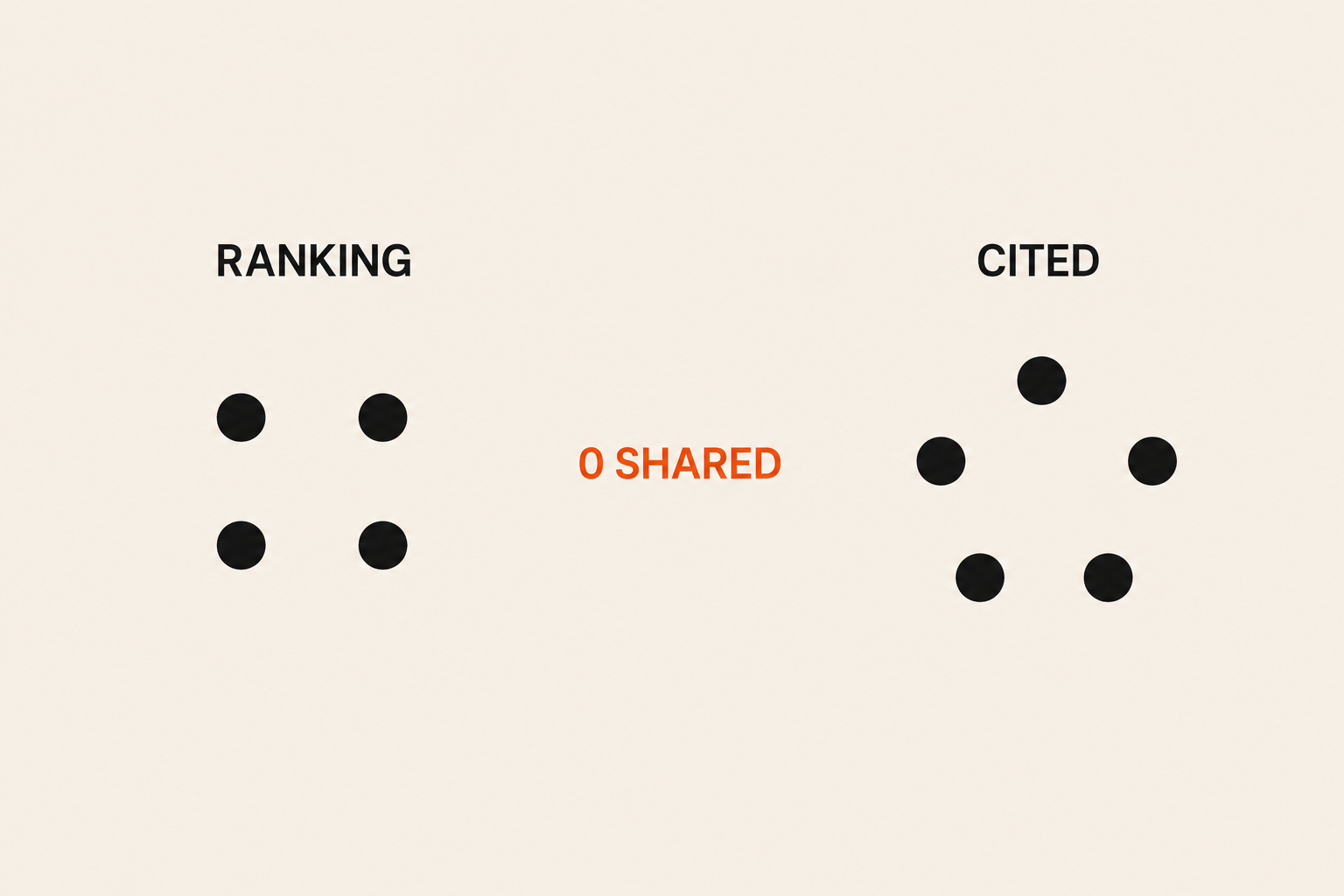
| Ranking conventionally | Cited by Google AI Mode |
|---|---|
| ahrefs.com | gptzero.me |
| blog.hubspot.com | amicited.com |
| get-ryze.ai | cxl.com |
| momenticmarketing.com | searchai-app.com |
| — | cloro.dev |
Four ranking domains, five cited domains, zero shared between them. One query, one snapshot — not a rate, and not a claim that this happens on every query in the cluster, because we haven’t checked every query in the cluster.
What it does establish, at least once: ranking and citation can be entirely separate competitive sets for the same query, at the same time, on the same day. If a citation strategy assumes today’s top-10 competitors are also tomorrow’s cited competitors, this is the data point that says check that assumption before building a strategy on top of it. Deciding which queries are worth that effort in the first place is a separate exercise, and the prioritization framework for it is queued next in this cluster.
What This Data Can’t Tell You
Three limitations sit underneath everything above, and skipping them would make this piece no more honest than the studies it’s pushing back on.
First, Bing’s AI Performance data is sampled, not exhaustive — Microsoft has said as much publicly — and it aggregates citations across Microsoft’s AI surfaces, including Copilot and Bing’s AI summaries, without isolating which specific product served each citation. A number attributed to one named product from this dashboard alone would be more precise than the dashboard actually supports, which is why this article doesn’t attribute the measured figures to Copilot specifically.
Second, this is one site. N of one. Every figure above describes what happened on ideapreneur.io, not what chunking does in general, and definitely not what it will do on a site in a different niche with a different starting level of authority.
Third, the competitive and demand research feeding this cluster — including the disjoint domain-set comparison above — was run from a Bangladesh IP against a North American and European buyer. AI-generated search results can vary by region, and we haven’t geo-verified these findings for the market they’re meant to describe. We’re saying so directly instead of letting the table pass as more universal than it is.
Common Mistakes Reading Chunking-to-Citation Data
A few ways this kind of data gets misread, roughly in order of how often we see them:
- Treating one site’s lift percentage as portable. A 65% improvement on one domain says nothing about what happens on yours — different entity authority, different competitive set, different starting point.
- Conflating citation count with citation share. Both can move in opposite directions at once, the way ours did. Reporting only the number that’s rising is cherry-picking, even when it isn’t intentional.
- Assuming the rank-set predicts the cite-set. The domain comparison above shows they can be entirely different competitors for the same query on the same day.
- Reading platform-aggregated data as single-surface data. If a dashboard pools multiple AI products into one number, don’t name one of those products in your headline stat.
- Treating one dated export as a trend. One reading is a snapshot. Two readings, taken with a stated method roughly two months apart, start to indicate a direction. Neither is proof.
So, Does Chunking Change Citation?
Chunking is a necessary condition, not a sufficient one. It doesn’t buy citation by itself — nothing in this data supports that claim — but its absence is a reasonably reliable way to make a page ineligible for citation in the first place, because passage-level retrieval can’t extract a passage that doesn’t function as one.
That’s a position, not a hedge, and it costs something if it turns out to be wrong. If chunking matters less than this article argues, sites that spent months restructuring content around answer-first sections did that work for a smaller return than expected, while the factors that may matter more — entity clarity, source authority, domain trust — went comparatively under-invested in the meantime. The data above, thin as it is, points toward chunking functioning as a floor rather than a lever. How much floor it actually is remains an open question, and we’re not going to round that up to sound more certain than the two dashboard readings behind it.
Frequently Asked Questions
Does chunking increase citation frequency on ChatGPT or Google AI Mode?
Not reliably on its own. On this site, a broader restructuring effort that included chunking coincided with a confirmed ChatGPT citation and a roughly 70% rise in Bing-tracked citations, but citation share fell over the same period, and several other changes happened alongside the chunking work. The honest answer is that chunking appears to be one input among several, not a standalone lever with a predictable, isolated return. A useful frame: treat chunking as removing a barrier to citation rather than as something that pulls citation toward a page on its own.
What is passage-level retrieval?
Passage-level retrieval is when an answer engine pulls a specific section of a page — rather than the page as a whole — to ground part of its response. It’s why a self-contained chunk of roughly 150 to 300 words that answers one question completely is easier to extract than a paragraph that depends on the sentences before or after it for meaning. In practice, this means writing each section so it could be read on its own, out of context, and still make complete sense to someone who never saw the rest of the page.
What’s the difference between a grounding query and a normal search query?
A grounding query is the internal reformulation an answer engine uses to retrieve source material for its response, and it doesn’t always match the phrase a person actually typed into a search box. This article’s own primary target behaves as a grounding-style phrase rather than a natural human search term — no People Also Ask box returned for the exact wording, even though the underlying demand for the topic is real. Treating the two as interchangeable is a common mistake when choosing what to target for AI citation specifically, as opposed to conventional keyword research.
Can a page rank on Google and never get cited by an answer engine, or the reverse?
Yes, to both. The domain comparison in this article shows a query where the four domains ranking conventionally and the five domains cited by Google AI Mode had zero overlap. Ranking and citation can be entirely separate competitive sets for the same query at the same time, which means optimizing purely for rank doesn’t guarantee citation eligibility, and vice versa. It’s a reminder that “who ranks” doesn’t automatically answer “who gets cited,” and a citation strategy built only on rank data risks missing where the real competition is happening.
What’s the difference between citation count and citation share?
Citation count is the raw number of times a page gets cited. Citation share is that count expressed as a percentage of total citations across a tracked set of queries. Both can move in opposite directions simultaneously — on this site, citation count rose roughly 70% while citation share fell about 4.5 percentage points over the same window, because the total query file being tracked grew faster than the site’s citations within it. A page can be one of the most-cited pages on a small query file, or a small share of a much larger one — the two numbers answer different questions, and neither alone tells the full story.
Does content need to be chunked correctly to get cited at all?
This article doesn’t test that directly — for the mechanics of writing an answer-first chunk, see how to write answer-first chunks. What this piece does show is that a chunked page can get cited on a query with no conventional ranking at all, which suggests structure affects eligibility for retrieval even where it hasn’t been proven to affect ranking. Eligibility and ranking are different claims, and this article is careful not to conflate them — getting the structure right may open the door without guaranteeing where the page lands on it.
Is a single dashboard reading enough to prove a citation trend?
No. One reading is a snapshot. This article relies on two dated readings taken with a stated method roughly two months apart, which starts to indicate a direction rather than proving one conclusively. Any single-reading claim — including some of the lift percentages this article cites from competitors — should be read with that same limit in mind. Reporting a single-export number without a second reading describes a moment, not a trend, regardless of how large the number looks.
Curious whether your own rank-set and cite-set diverge the way this article’s did? That’s a five-minute check on your own tracked queries before you invest another restructuring pass anywhere.
Find out which Citation Architecture signals your content is missing.
Run Free Check →