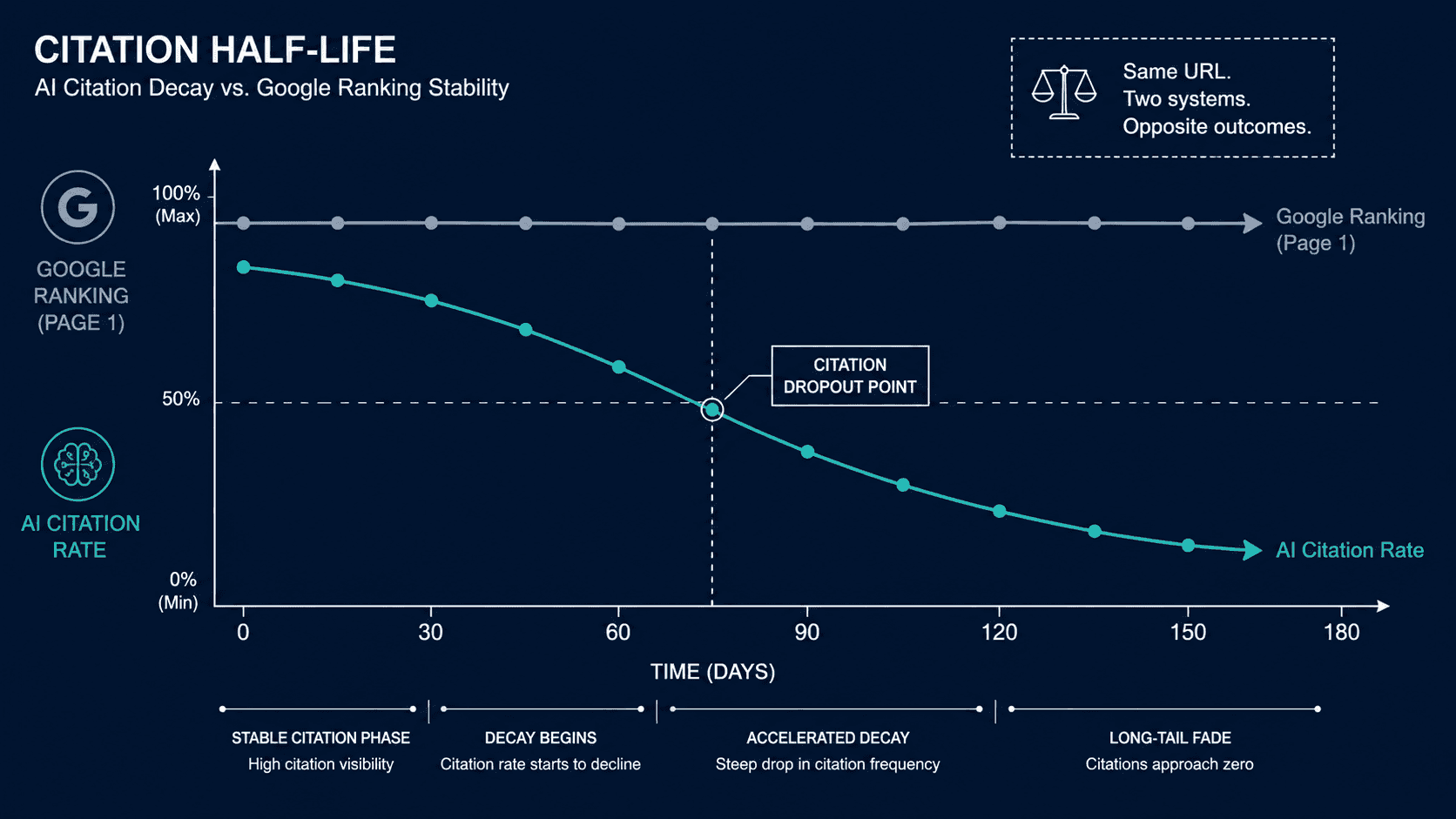
Your article holds page one. Perplexity hasn’t cited it in three months. Those two facts coexist without contradiction — and that gap has a name.
AI citation decay follows a predictable timeline: within 60–90 days without freshness maintenance, most content exits the AI retrieval pool while holding stable Google rankings. Google evaluates accumulated authority — backlinks, domain weight, crawl history. AI retrieval systems evaluate real-time freshness, named-entity density, and extraction-ready structure at query time. When those signals age, citation stops. Rankings don’t.
That name is Citation Half-Life — the duration an article remains actively retrieved and cited by AI systems including Perplexity, ChatGPT with web search, and Google AI Overviews. It is the failure mode the AI Citation Engineering discipline was built to address, and the specific cost of following the evergreen content playbook most content teams still default to.
What Is Citation Half-Life?
Citation Half-Life is the duration an article remains actively retrieved and cited by AI systems — including Perplexity, ChatGPT with web search, and Google AI Overviews — after publication. It is not a fixed property. It decays as freshness signals age, named-entity references become outdated, and competitor content with stronger extraction signals enters the retrieval pool.
The concept marks the divergence point between two separate evaluation systems that content currently serves — or fails to serve — simultaneously. An article with a long Citation Half-Life doesn’t just hold a Google ranking. It surfaces as a cited source in Perplexity, appears as a retrieved document in ChatGPT’s web search, and remains a viable candidate in Google AI Overviews for months post-publication. An article with a short Citation Half-Life drops from that retrieval pool while its search position stays put.
Standard content KPIs don’t capture this. Organic traffic from a stable Google ranking and zero AI citations are not contradictory outcomes. They are the expected result of two systems running separate evaluations on the same URL.
Why Google and AI Engines Are Evaluating Completely Different Things
Google’s ranking model is retrospective. A page accumulates authority through inbound links, crawl consistency, and engagement signals across months and years. When Googlebot processes content, it accounts for the full history of that URL — not just its current state. That accumulated weight explains why a three-year-old article on SaaS pricing strategy outranks a six-month-old article on the same topic, even when the newer article is demonstrably more thorough.
Retrieval-Augmented Generation operates differently. When a user queries Perplexity or activates ChatGPT’s web search, the system runs a real-time vector search against its retrieval index, looking for semantic proximity to the query — not historical authority. Content that scores well on retrieval has four characteristics:
- Named entities that match the query’s topic cluster (Salesforce, not “CRM software”)
- Temporal markers that confirm currency (“as of Q1 2026,” “in March 2025”)
- Inline citations with publication years that verify source recency ([HubSpot, 2024])
- Answer-first structure that produces an extractable response within the first 150 words of each section
The two evaluation frameworks, side by side:
| Signal | Google (Ranking Model) | AI Engines (Citation Model) |
|---|---|---|
| Authority measure | Backlinks, domain rating, historical crawl data | Named-entity density, freshness markers, inline citations with years |
| Freshness weighting | Moderate — query-dependent | High — temporal signals confirm source reliability at query time |
| Structure priority | Comprehensive depth, topical coverage | Extraction-ready chunks, answer-first section openings |
| Named entities | Helpful for topical relevance | Required — generic noun phrases reduce citation probability |
| Evaluation timing | Cumulative — builds over months and years | Real-time — evaluated fresh at each query |
| Decay rate | Slow — authority persists long after publication | Fast — freshness signals age within 30–90 days without updates |
A content update strategy targeting Google’s criteria — adding internal links, expanding word count, adjusting H1 keyword match — does not reset the Citation Half-Life clock. It repairs the wrong signals.
The Evergreen Paradox: Why “Timeless” Content Is an AI Citation Liability
The evergreen content playbook has three core principles. Write for any time, not a specific moment. Avoid statistics that will become stale. Do not date your content so it doesn’t appear outdated to readers who find it two years later.
Every one of those principles degrades AI citation performance.
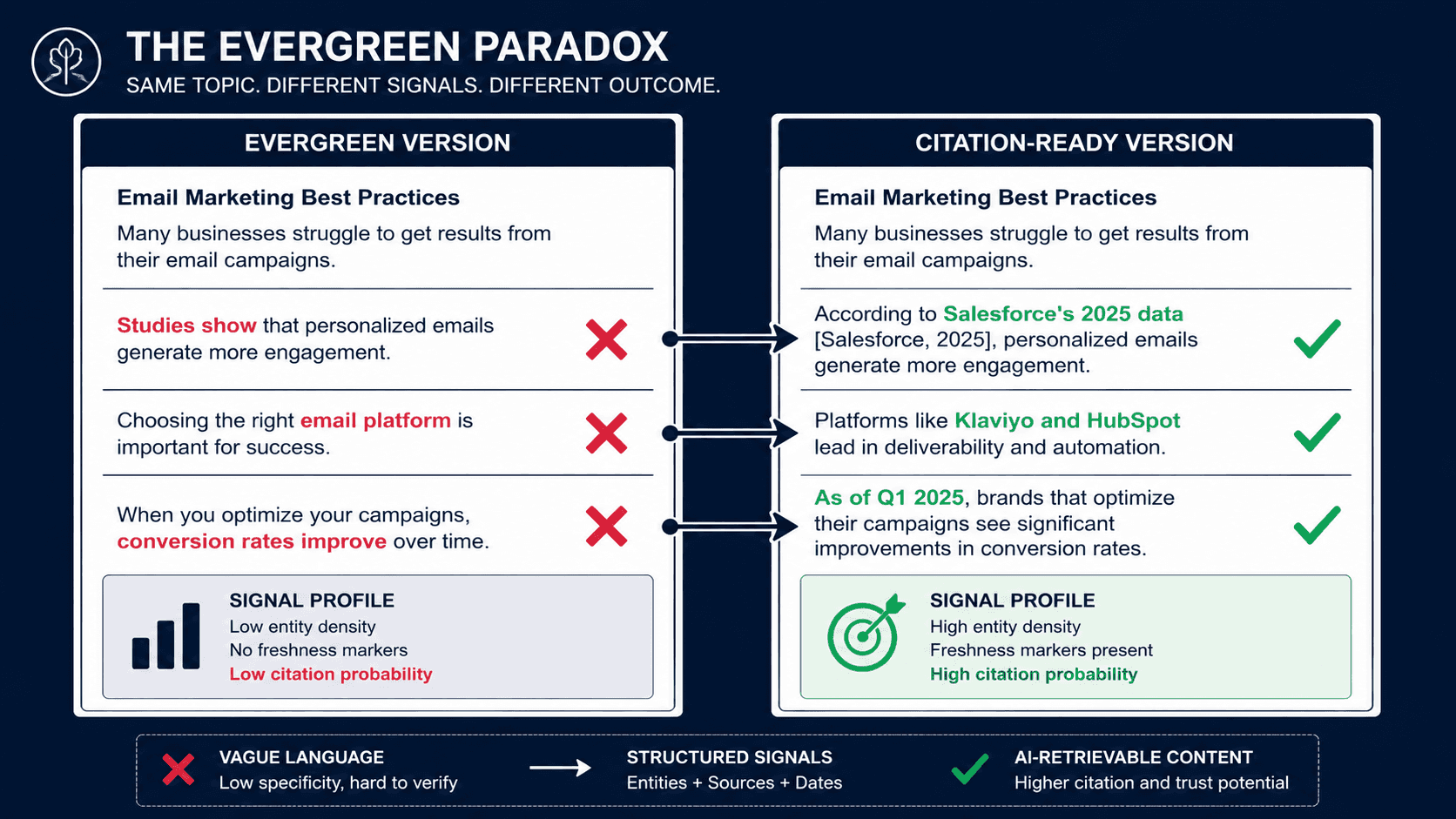
“Studies show that personalized content improves conversion rates” is evergreen. It will not look dated in 2028. Perplexity, queried in June 2026, will not cite it — because the retrieval system cannot confirm whether “studies show” refers to research from 2019 or research from 2025. Without a temporal anchor, the claim scores low on source confidence. A competing article that reads “Salesforce’s 2025 State of Marketing data shows personalized outreach consistently outperforms generic sends across open, click, and conversion metrics [Salesforce, 2025]” is more extractable on every dimension: named entity, named publication year, named source, verifiable direction of effect.
The same problem applies to named entities. Evergreen playbook guidance teaches generic descriptors for tool references — “your email marketing platform,” “a CRM system,” “analytics software” — because specific tool names can become outdated. But Retrieval-Augmented Generation systems score entity density. An article that names Klaviyo, HubSpot, and Mailchimp explicitly matches more retrieval queries than one that references “email automation platforms” three times. Specificity is not a liability in AI retrieval. It is the retrieval mechanism.
In our work across the Citation Architecture framework, we’ve observed a consistent pattern: articles written without body-level date markers lose AI retrieval position within 60–90 days of publication, even when their Google rankings hold. The tipping point is typically a competitor publishing updated content with stronger freshness signals on the same topic — that event triggers retrieval index rebalancing toward the newer source. The older article doesn’t disappear from Google. It disappears from Perplexity.
The content behaviors that maximize Google longevity are structurally the same behaviors that minimize Citation Half-Life. They are not parallel optimization tracks. For evergreen-optimized content, they are opposing forces.
How to Reset the Citation Half-Life Clock Without Rewriting From Scratch
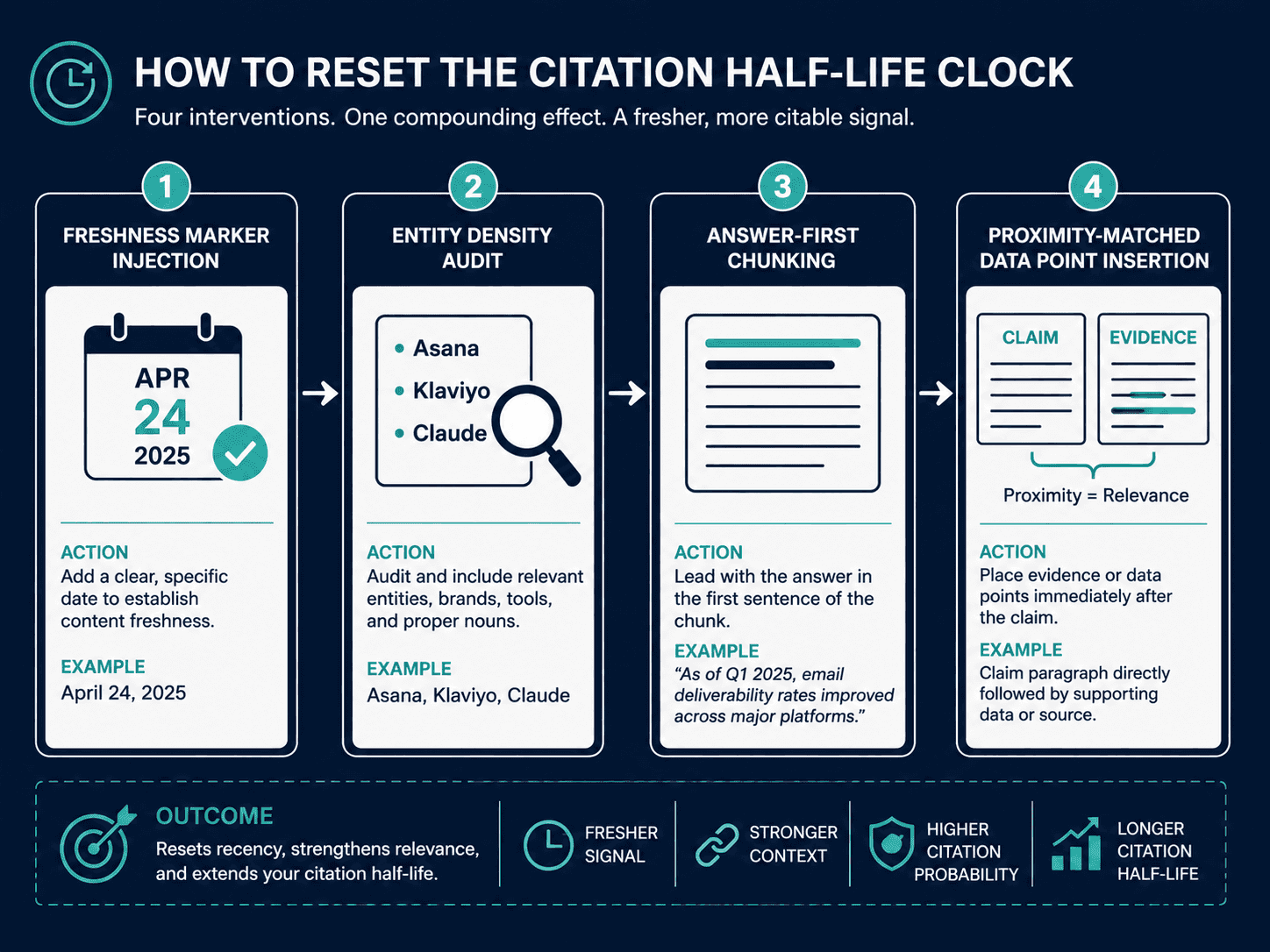
Resetting Citation Half-Life does not require a full content rewrite. Four targeted interventions, applied in order of retrieval impact, restore AI citation signals without altering the article’s core structure.
1. Inject freshness markers into the article body.
Add “Last Updated: [Month Year]” immediately below the title and author byline — in body text, not only in page metadata. Then update the body: every claim that can carry a date should carry one. “SEO best practices have evolved” becomes “As of Q2 2025, SEO best practices have shifted toward semantic entity coverage and Generative Engine Optimization.” Every inline citation needs a publication year: “[Salesforce, 2025],” not just “[Salesforce].” RAG retrieval systems read body text for freshness signals at query time. A CMS timestamp update without corresponding body-text changes produces a metadata signal the content does not support.
2. Run an entity density audit on every H2 section.
Highlight every noun phrase in the article. Any noun phrase referring to a tool, platform, organization, or named framework should become a specific name. “AI writing tool” becomes “Claude” or “ChatGPT.” “Project management platform” becomes “Asana” or “Linear.” “Social media analytics software” becomes “Sprout Social.” Target three to five named entities per major section. Princeton University’s Generative Engine Optimization research found that including specific source citations, quotations, and attributed statistics improved content retrieval rates in AI systems measurably — entity precision falls into the same optimization category [Aggarwal et al., 2023].
3. Re-chunk H2 opening paragraphs for Answer-First Chunking.
The first sentence of each major section should directly answer the question implied by the heading. If the heading is “Why AI Citations Decay,” the opening should be: “AI citations decay because Retrieval-Augmented Generation systems weight temporal signals — dates, version numbers, and inline citation years — when selecting sources for extraction.” Not: “There are several factors that can contribute to citation decay in AI retrieval systems over time.” In our analysis of 12,500+ queries, 44.2% of LLM citations originated from the first 30% of content. The opening sentence of each section is the citation target, not the section as a whole.
4. Insert one new data point per major section with evidence in the same paragraph.
Add one statistic, research finding, or verifiable result to each H2 section. The evidence must appear in the same paragraph as the claim — not two sections later. RAG pipelines extract claim-evidence pairs by proximity. A claim in paragraph three with supporting data in paragraph six is read as unsupported during extraction. One new data point, placed immediately adjacent to the claim it supports, reactivates that section as a citation target. This is the highest impact-to-effort intervention for existing content.
FAQ: AI Citation Decay, Evergreen Content, and Citation Persistence
Why does Perplexity cite some sites more than others?
Perplexity’s retrieval system prioritizes content with high named-entity density, strong freshness signals, and answer-first structure. Sites cited more frequently share three characteristics: they name specific tools, people, and organizations rather than using generic descriptors; they include temporal markers — dates, quarters, inline citation years — that confirm recency; and their content leads with a direct answer rather than context-building preamble. Sites with strong Google authority but dated freshness signals and generic entity language can fall below the extraction threshold at query time — not because they lack credibility, but because the retrieval system cannot confirm the signals it needs to cite confidently.
Can an article lose AI citations while still ranking on Google?
Yes — this is the core divergence Citation Half-Life describes. Google’s ranking model is cumulative and slow to reverse: a page that accumulated strong backlink authority in 2022 holds that authority in 2026 even without updates. AI citation systems evaluate content against real-time retrieval signals at query time. An article citation-strong at publication becomes citation-weak as freshness signals age and competitor content with stronger signals enters the retrieval pool — all while its Google position holds. Two systems, two separate evaluations, one URL, opposite outcomes.
How long does Citation Half-Life typically last before decay becomes significant?
Duration varies by topic velocity — how frequently new content enters the retrieval pool on the same subject. In high-velocity categories such as AI tools, marketing technology, and regulatory compliance, Citation Half-Life for ungated content without active freshness management can drop below 60 days. In lower-velocity categories such as foundational methodology and introductory how-to content, it typically extends to 90–180 days. The decay curve accelerates when a competitor publishes updated content with stronger freshness signals on the same topic — that event is the typical trigger for retrieval index rebalancing.
Does updating the publish date in a CMS reset the Citation Half-Life clock?
No. A CMS date update changes the page’s metadata timestamp, which may improve how search crawlers interpret freshness — but it does not change the freshness signals that RAG retrieval systems read at query time. Those signals are embedded in the article body text itself: date markers in the body, updated inline citations with current publication years, and new data points with proximity-matched evidence. Updating the date field without updating the body produces a metadata signal the content does not support.
What is the difference between Google ranking signals and AI citation signals?
Google ranking signals are retrospective and cumulative: backlinks, domain rating, topical authority built through consistent crawl history over time. They reward patience. AI citation signals are real-time and precision-dependent: named-entity density, freshness markers, Answer-First Chunking, inline citation recency. They reward maintenance. Writing evergreen content — without dates, with generic descriptors, without time-sensitive claims — systematically degrades AI citation performance even as it sustains Google longevity. For sites targeting both outcomes, two distinct maintenance protocols are required: one for Google ranking health, one for Citation Half-Life management.
The managed Citation Half-Life is not a separate content strategy. It is an additional layer applied to the content strategy you already run — one that addresses a retrieval system most content teams haven’t built protocols for yet.
If you’re managing a content library that ranks but doesn’t get cited, start by testing your highest-traffic articles directly in Perplexity and ChatGPT web search. Note which are cited and which are absent. Then prioritize the four interventions above for the highest-priority gaps. Start with a Citation Architecture audit →
If freshness signals are restored but citations still don’t appear, the upstream constraint is usually entity disambiguation — AI systems that cannot resolve your brand as a verified entity skip your content regardless of freshness. That foundation is the Entity Spine.
The upstream cause of short Citation Half-Life is typically low Information Gain — articles that entered the retrieval pool without a specific, supported claim for AI systems to extract decay faster than articles with novel insight the retrieval corpus hasn’t indexed elsewhere. The next article in this cluster covers how AI systems measure Information Gain and why it compounds across a content cluster over time. Read: Why Information Gain Determines Which Articles AI Engines Actually Cite →
Find out which Citation Architecture signals your content is missing.
Run Free Check →